People always ask me how I pick where to go next. My honest answer is simple: I follow the math. A destination that costs $40 a day and gives me good food, good weather, and enough to actually do is worth ten times a destination that costs $120 and forces me to budget every coffee. That math, specifically, led me to each of the eleven places below.
- 1. Tbilisi and the Caucasus, Georgia: $26 a Day
- 2. Lisbon and the Alentejo, Portugal: $65 a Day (But Worth Knowing How)
- 3. Chiang Mai, Thailand: $28 a Day
- 4. Oaxaca, Mexico: $35 a Day
- 5. Hoi An and Da Nang, Vietnam: $22 a Day
- 6. Kotor and the Bay of Kotor, Montenegro: $35 a Day
- 7. Cartagena and the Coffee Region, Colombia: $32 a Day
- 8. Plovdiv and the Rhodope Mountains, Bulgaria: $30 a Day
- 9. Krakow and Southern Poland: $35 a Day
- 10. Split and the Dalmatian Islands, Croatia (Shoulder Season Only): $45 a Day
- 11. Kyoto and Hiroshima, Japan: $40 a Day (With the Right Strategy)
- 2026 Best Budget Travel Destinations Comparison
- How to Find Deals Not Listed Anywhere
- Frequently Asked Questions
- You Might Also Like
The best budget travel destinations for 2026 are not just the cheapest spots on earth. They are places where the price gap between what you pay and what you get is genuinely exciting. Some of these are well-known, and a few are still largely off the radar for English-speaking travelers. All of them are places I have personally spent time, tracked my spending, and left wishing I had stayed longer.
Every destination below comes with my real daily average — verified against Numbeo’s cost of living index, what I liked most, what surprised me, and one tip I wish someone had given me before I arrived. If you want more on planning the trip itself, my budget travel planning guide covers the logistics side. Here are the eleven best budget travel destinations for 2026, ranked loosely by overall value.
The best budget travel destinations for 2026 give you an experience that far exceeds what you pay. Tbilisi, Georgia leads at $26/day. Chiang Mai follows at $28/day. Oaxaca, Mexico delivers colonial charm at $35/day. All 11 destinations on this list were personally visited in 2024 or 2025 with daily spending tracked.
1. Tbilisi and the Caucasus, Georgia: $26 a Day
Before you book anything
-
✓
Travel in shoulder season: May, June, and September cut accommodation costs by 30 to 50 percent at every destination on this list. Crowds drop, service improves, weather stays excellent. -
✓
Stay in one place longer: Moving every two days costs money in transit, storage fees, and time. Five to seven nights in a single base cuts daily average costs significantly. -
✓
Use IC cards and transit apps: Every destination here has a digital transit payment system. Loading one on arrival saves 40 to 70 percent versus buying individual tickets.
Georgia sits at the intersection of Europe and Asia and prices its hospitality to match neither. In Tbilisi’s old town, where balconied wooden houses overhang cobblestone alleys, boutique guesthouses with courtyard breakfasts cost $14 to $18 a night. The breakfasts are enormous: fresh bread, white cheese, tomatoes, cucumbers, boiled eggs, honey, and a pot of strong coffee.
In fact, the food alone makes this one of the best budget travel destinations for 2026. Khinkali dumplings stuffed with spiced beef and broth cost $2 for a full plate of five. Churchkhela, the grape-and-walnut candy sold at every street stall, costs fifty cents a stick. A carafe of Georgian natural wine at a rooftop bar runs $4. A whole evening out, dinner plus drinks, rarely tops $10.
Beyond the city, the country opens up dramatically. The Kakheti wine region is an hour by marshrutka. The Kazbegi mountains with the Trinity Church on a cliffside ridge take two hours. Batumi on the Black Sea coast is four hours. All of these cost under $10 in transport each way.
Furthermore, Georgia offers one-year visa-free access to citizens of nearly one hundred countries. There is no easier affordable country to stay in long-term.
- Accommodation: $14–$18 for boutique guesthouse rooms with breakfast
- Food: $7–$9 for full meals with wine
- Transport: $3–$5 including metro, marshrutka minibuses, and regional trips
The Tbilisi Free Walking Tour departs every day at 11:00 AM from Freedom Square and covers three hours of the old city, the fortresses, the sulfur baths, and the Narikala ruins. It is free (tip-based) and run by a rotation of genuinely passionate local guides, making it the single highest-value few hours you can spend in the city.
2. Lisbon and the Alentejo, Portugal: $65 a Day (But Worth Knowing How)
Portugal sits above most true budget destinations on cost, but it earns its place on this list because of the Alentejo interior. Stay in Evora or Beja rather than Lisbon, and your daily costs collapse to $35 to $40. A private room in a heritage guesthouse in Evora costs $22. A full “prato do dia” (daily lunch plate) at a neighborhood taberna runs $7 and includes soup, a generous main course, bread, water, and sometimes a small dessert.
That said, Lisbon itself requires strategy. Stay in the quieter neighborhoods of Mouraria or Mouraria-adjacent Intendente rather than Alfama or Bairro Alto, and your accommodation costs $25 to $35 for a clean private room. The city’s pastries are legendary and cost one euro each at any historic pastelaria. The LX Factory market on Sundays offers a free afternoon of street food, local crafts, and live music.
Additionally, Portugal is one of the easiest European countries for American, Canadian, and British travelers to get around without learning the language, though Portuguese locals appreciate any attempt at “bom dia” and “obrigada.”
- Accommodation: $22–$35 depending on Alentejo versus Lisbon
- Food: $10–$14 for a daily prato do dia and breakfast pastry
- Transport: $5–$7 for metro cards and regional Comboios de Portugal trains
Buy a Viva Viagem reloadable transit card in Lisbon for 50 cents at any metro station and load it with the “24-hour travel card” for €6.70. It covers unlimited metro rides plus the iconic Trams 28 and 15E that tourists pay single fares of €3 each to board.
3. Chiang Mai, Thailand: $28 a Day
Chiang Mai is one of those cities that travelers discover for a weekend and end up staying in for three months. It happens constantly. The city is easy, affordable, and endlessly comfortable. A private boutique guesthouse room with a pool in the Nimman or Santitham neighborhood costs $12 to $16 a night. Coworking spaces with fast internet start at $5 a day.
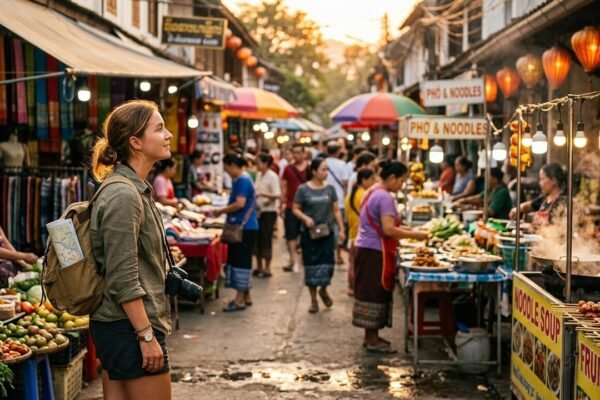
However, the food scene is the best part. Northern Thai cuisine is entirely different from southern Thai or Bangkok street food. Khao soi, the coconut milk curry noodle soup topped with crispy egg noodles and a wedge of lime, costs $1.50 at any neighborhood noodle shop. A plate of garlic-fried morning glory with jasmine rice is $1. A full sit-down dinner at a wooden shophouse restaurant runs $4 to $5.
Moreover, day trips from Chiang Mai cost almost nothing by public transport. Doi Suthep temple is a 30-baht (under $1) songthaew ride from Nimman Road. The Samoeng Loop scooter route through mountain villages costs $6 for the bike rental plus $2 in petrol. White-water rafting on the Maetaeng River costs $25 for a full day including transport and lunch.
- Accommodation: $12–$16 for private boutique guesthouses or serviced apartments
- Food: $6–$8 for full days of northern Thai meals and fresh fruit shakes
- Activities: $5–$10 for day trips including scooter rental
Avoid Songthaew drivers who approach you unprompted at the Old City gates. Walk one block away and flag down a passing red songthaew directly. Negotiate before getting in and expect to pay 30 to 50 baht (under $1.50) for any in-city route, not the 100 to 200 baht tourists get quoted at major landmarks.
4. Oaxaca, Mexico: $35 a Day
Oaxaca sits in a highland valley in southern Mexico and feels like a city that belongs to a different era. Adobe buildings painted in warm ochre and terracotta line cobblestone streets. Markets overflow with chili peppers, chocolate, hand-woven textiles, and mezcal. Private rooms in charming colonial guesthouses cost $18 to $22 a night.
Specifically, the food here is some of the most complex and affordable in the Americas. A full plate of mole negro with tender chicken, served with fresh tortillas and beans, costs $4 at a market comedor. A half-liter of house mezcal at a neighborhood bar is $3. Tlayudas, the giant flat crispy tortillas loaded with beans, quesillo cheese, and grilled meat, cost $2 at the night market stalls.
For day trips, Oaxaca delivers exceptional value. Monte Alban, the ancient Zapotec capital on a flattened hilltop with views of the entire valley, costs $5 to enter. The Hierve el Agua petrified waterfall and natural infinity pool is $3 for the entrance. A full shared day tour hitting both sites costs $15 including transport.
- Accommodation: $18–$22 for charming colonial guesthouse rooms
- Food: $9–$12 for full market meals, street tacos, and mezcal
- Activities: $5–$15 for ruins, cooking classes, and valley day trips
Go to the Mercado 20 de Noviembre for lunch rather than Mercado Benito Juarez. The 20 de Noviembre market has the grill corridor (the “pasillo de humo”) where vendors char-grill meat cuts directly in front of you. A full plate with accompaniments costs $3 to $4 and the quality is consistently excellent.
5. Hoi An and Da Nang, Vietnam: $22 a Day
Vietnam appears twice on this list in different forms because the country genuinely offers that much value. Hoi An specifically occupies a strange and wonderful middle ground: it is one of the most photogenic small towns in Asia, it has a UNESCO-protected ancient town, and it costs almost nothing. Private rooms in garden guesthouses outside the ancient town center cost $9 to $12 a night.
Indeed, the food is the main event. Cao lau, a regional noodle dish made with pork char siu, crispy rice crackers, and fresh herbs served over thick chewy noodles, is specific to Hoi An and costs $1.50 at any street stall. Banh mi from the famous Phuong bakery, consistently cited as one of the best in Vietnam, costs $1. A fresh spring roll with shrimp and herbs, made by hand at your table, is $0.75.
Meanwhile, Da Nang — thirty minutes north by bus — offers a complementary experience: a modern city with clean beaches, craft beer bars, and a transit infrastructure that makes moving around extremely easy. My Southeast Asia travel tips covers the best ways to combine both cities in a single trip.
- Accommodation: $9–$12 for private guesthouse rooms in Hoi An
- Food: $5–$7 for full days of street meals and Vietnamese coffee
- Transport: $2–$3 for local buses and Grab scooter rides
In Hoi An, rent a bicycle for the day from your guesthouse for $1 to $2 and ride along the river road south toward An Bang Beach, about 4 kilometers outside the ancient town. The beach there has far fewer crowds than China Beach in Da Nang, beach chairs rent for free with a drink order, and the sunset view is unobstructed.
6. Kotor and the Bay of Kotor, Montenegro: $35 a Day
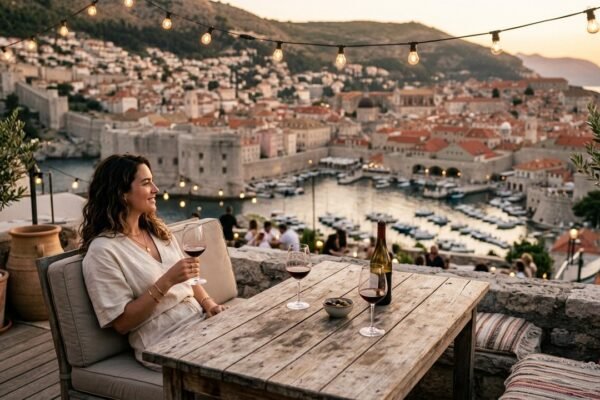
Montenegro remains one of the most beautiful and least visited countries in the Mediterranean in 2026. The Bay of Kotor, a landlocked fjord ringed by medieval walls and Venetian-era towns, looks like it belongs on a painter’s canvas. Staying inside the old walled city of Kotor during May or September, private rooms in stone guesthouses cost $20 to $28 a night. The same rooms cost triple in July and August.
Restaurants inside the walls serve fresh Adriatic fish, black risotto, and local wine for $10 to $14 a full dinner. Wine on the waterfront terrace runs $3. The entire old city is walkable in twenty minutes, but climbing the fortress walls to the Church of Our Lady of Remedy takes forty-five minutes and costs $4, rewarding you with a view of the entire bay.
Still, Montenegro does not yet have the tourist infrastructure of Croatia, which keeps prices significantly lower and crowds considerably thinner. In fact, ferry boats cross the bay between Lepetane and Kamenari for $3 and depart every fifteen minutes, connecting you to the quieter villages on the far shore.
- Accommodation: $20–$28 inside the old city walls (much less outside)
- Food: $10–$14 for fresh seafood dinners and local wine
- Transport: $3–$6 for bay ferries and local buses
Visit the village of Perast, twelve kilometers up the bay from Kotor, for an hour before heading back. Boats to the Our Lady of the Rocks island church depart from the waterfront for $5 per person, and the village itself has almost no tourist infrastructure, meaning its waterfront restaurants charge local prices despite the spectacular setting.
7. Cartagena and the Coffee Region, Colombia: $32 a Day
Colombia offers two completely different budget experiences and both are excellent. Cartagena on the Caribbean coast is colorful, walkable, and dense with history. The walled city’s candy-colored colonial buildings make it one of the most photogenic places in South America. Private rooms inside the walls cost $18 to $22 a night. Street food is exceptional: arepas de choclo with cheese cost $0.75. A fresh tropical fruit salad with condensed milk and coconut shavings is $1.50.
In contrast, the Coffee Region (Eje Cafetero) around Salento, Jardin, and Manizales offers a completely different side of Colombia. Coffee fincas rent private rooms with mountain views for $15 to $20 a night including breakfast. The breakfast usually includes strong local pour-over coffee, fresh pandebono cheese bread, tropical fruit, and eggs. Jeep rides up into the wax palm valleys of Cocora cost $2 each way.
Notably, these two regions are connectable without flying. A comfortable overnight bus from Bogota to Salento or Jardin costs $12 to $15 and leaves you refreshed in the morning mountain air.
- Accommodation: $15–$22 depending on city versus coffee finca
- Food: $9–$11 for daily menu del dia plates and street snacks
- Transport: $4–$6 for city transit and intercity overnight coaches
In Salento, buy your coffee directly from the small producers who set up tables outside the central plaza on weekend mornings. Prices are lower than the tourist shops on the main street, and the producers will let you taste several varieties before you choose. A 250-gram bag of specialty-grade Colombia washed coffee runs $4 to $6.
8. Plovdiv and the Rhodope Mountains, Bulgaria: $30 a Day
Bulgaria is one of the most underestimated countries in Europe for budget travelers, and it consistently surprises people who land there expecting less. Plovdiv, the second-largest city, has a historic old town of Ottoman-era mansions and Roman ruins that is genuinely spectacular and almost entirely overlooked by Western European tourists. A private room in a beautifully restored old town guesthouse costs $15 to $20 a night.
Also, Bulgarian food is hearty, fresh, and inexpensive. A bowl of shopska salad, the national salad of chopped tomatoes, cucumbers, and roasted peppers topped with generous amounts of grated white sirene cheese, costs $2.50. Kavarma, a clay-pot-cooked stew of pork or chicken with peppers and onions, costs $4. Local Mavrud red wine, one of Bulgaria’s indigenous grape varieties, runs $1.50 at any neighborhood mehana taverna.
Beyond Plovdiv, the Rhodope Mountains are wild, forested, and almost entirely free of tourist development. Villages like Shiroka Laka and Mogilitsa have homestays for $15 a night including dinner. The Trigrad Gorge and the Devil’s Throat cave are accessible by local bus for $2.
- Accommodation: $15–$20 for old town guesthouses in Plovdiv or mountain homestays
- Food: $8–$10 for full Bulgarian meals with salad, main, and wine
- Transport: $3–$5 for city trams and regional mountain buses
Plovdiv’s old town restaurants near the Kapana arts district quote prices in Bulgarian lev. One lev is about 55 US cents. Many tourists assume the menu prices are in euros and tip accordingly, which is generous but unnecessary. Ask for the lev price and tip 10 to 15 percent, which is the local standard and still greatly appreciated.
9. Krakow and Southern Poland: $35 a Day
Krakow is one of the most accessible budget destinations in Central Europe and it remains significantly cheaper than Prague or Budapest in 2026. The historic center is a UNESCO World Heritage Site, compact enough to walk across in thirty minutes, and ringed by affordable accommodation options. A private studio apartment three blocks from the main square costs $20 to $25 a night.
Furthermore, Polish food is some of the most generous-portioned and affordable in Europe. The pierogi at the iconic Milkbar Tomasza cost $4 for a plate of eight. The traditional zurek white sour rye soup served in a bread bowl runs $3. A stein of local craft beer at a Kazimierz brewery pub costs $2. A full dinner with three courses rarely tops $12.
Save this for later on Pinterest!
Follow us for more honest budget travel guides: @savydispatches on Pinterest
Similarly, southern Poland around the Tatra Mountains is equally affordable. The mountain resort town of Zakopane is a 2-hour bus from Krakow for $3. Homestays in the Tatra foothills cost $15 a night with breakfast. Cable car rides to the ridgeline cost $8.
- Accommodation: $20–$25 for private studio apartments near the center
- Food: $10–$12 for milk bar meals, bakery pastries, and warming soups
- Transport: $3–$5 for trams and regional mountain bus routes
Walk east from the main Krakow square into the Kazimierz district for dinner instead of eating at restaurants directly on Rynek Glowny. Kazimierz has the same quality of restaurants for forty percent less and a livelier, more local evening atmosphere. The Sunday flea market at Plac Nowy is completely free to browse and full of interesting finds.
10. Split and the Dalmatian Islands, Croatia (Shoulder Season Only): $45 a Day
Croatia in July and August is expensive — often comparable to Spain or France. Split in May, June, or September is a completely different calculation. Outside peak season, private rooms in the old city’s limestone warren of alleys cost $25 to $35 a night. Ferry tickets to the islands of Hvar, Brac, and Korcula drop to $5 to $8 one-way. Waterfront restaurants lower their prices and actually have room for walk-in diners.
That said, the Dalmatian coast is one of the most beautiful stretches of Mediterranean shoreline in the world, and shoulder season gives you access to it without the cruise ship crowds or the July heat. The water temperature in September is still warm enough to swim comfortably through the end of the month.
As a bonus, Split’s old city — built inside the walls of Diocletian’s 3rd-century Roman palace —, is free to walk through at any hour. The Peristyle courtyard at the center becomes a free open-air concert venue on summer evenings. The Marjan Hill park above the city gives panoramic views of the bay and islands for the cost of a thirty-minute walk.
- Accommodation: $25–$35 in May, June, and September (budget $60+ for July and August)
- Food: $12–$16 for fresh seafood, local pasta, and Dalmatian wine
- Transport: $5–$8 for island ferry tickets
Take the ferry to the island of Solta rather than the more famous Hvar for a day trip from Split. The crossing takes forty-five minutes and costs $5. Solta has olive farms, quiet fishing villages, and a single small town with an excellent waterfront restaurant where grilled fish is priced per kilogram at local rates. Almost nobody else is there.
11. Kyoto and Hiroshima, Japan: $40 a Day (With the Right Strategy)
Japan appears expensive at first, but that changes once you learn two things: how to eat like a local, and how to use the public baths and guesthouses properly. Budget capsule hotels and guesthouses in Kyoto cost $18 to $25 a night. Hiroshima guesthouses run $15 to $22. The shinkansen bullet train between the two cities takes forty-five minutes and costs $19.
In fact, eating from convenience stores (7-Eleven, FamilyMart, Lawson) is genuinely good in Japan and costs $4 to $6 for a full meal. A fresh onigiri rice ball is $1. From a standing ramen bar, a warm bowl of dashi broth noodles costs $4. A lunch set at any neighborhood teishoku restaurant, including rice, miso soup, pickles, and a grilled fish or meat main, costs $6 to $8.
Meanwhile, most of Kyoto’s famous temples and shrines are free or charge $3 to $5 to enter the inner sanctuary. Fushimi Inari, the mountain covered in thousands of red torii gates and one of the most photographed places in Asia, costs nothing at all. The surrounding neighborhoods of Nishiki Market and Gion are best explored on foot for free.
- Accommodation: $18–$25 for capsule hotels and guesthouses
- Food: $10–$14 using a combination of convenience stores and teishoku restaurants
- Transport: $5–$8 for daily IC transit cards and local bus passes
Buy an IC card (Suica or ICOCA) at any major train station the moment you land in Japan. Load it with 3,000 yen (about $20) and it covers every subway, bus, and local train in both Kyoto and Hiroshima without needing to buy individual tickets each time. It also works at nearly every convenience store and vending machine.
2026 Best Budget Travel Destinations Comparison
| Destination | Daily Budget | Best Season | Visa-Free for Most? |
|---|---|---|---|
| Vietnam (Hoi An) | $22 | November–March | Yes (30 days) |
| Georgia | $26 | May–June, Sept–Oct | Yes (1 year) |
| Chiang Mai | $28 | November–February | Yes (30 days) |
| Oaxaca | $35 | November–April | Yes |
| Montenegro | $35 | May–June, September | Yes |
| Krakow | $35 | May–June, Sept–Oct | Yes (EU) |
| Colombia | $32 | December–March | Yes |
| Bulgaria | $30 | May–September | Yes (EU) |
| Lisbon/Alentejo | $40–$65 | March–June | Yes (EU) |
| Croatia (shoulder) | $45 | May–June, September | Yes (EU) |
| Japan | $40 | March–May, October | Yes (90 days) |
How to Find Deals Not Listed Anywhere
Three tactics that have saved me thousands of dollars across hundreds of travel days:
Look at travel forums posted in the last 90 days. Blog posts go stale fast. Reddit’s r/solotravel and r/travel have threads updated daily with real current prices. When I cannot find a price I trust, I search “budget [city] 2026” on Reddit before booking anything.
Book accommodation for three nights, not one. Most guesthouses and small hotels give a silent discount to guests who stay longer. They will not advertise this. They will just offer you a better rate when you ask directly at check-in.
Fly into secondary airports. Arriving into Girona instead of Barcelona, Ciampino instead of Rome, or Charleroi instead of Brussels cuts flight costs by 40 to 70 percent. Trains and buses from secondary airports cost $5 to $15 and take thirty to sixty minutes. It is almost always worth it.
Frequently Asked Questions
What is the best budget travel destination for first-time solo travelers?
Chiang Mai, Thailand is my top recommendation. It is safe, easy to get around, English is widely spoken, the food is extraordinary, and $28 a day gives you a comfortable, full experience with room to spare.
Which of these destinations work best for longer stays of a month or more?
Georgia, Colombia, and Chiang Mai are the strongest picks for longer stays. All three have excellent co-working infrastructure, year-round pleasant climates, and monthly apartment rental rates that make them even cheaper than the daily figures above.
How accurate are these daily budget figures?
These are my personal averages across at least one extended stay at each destination in 2024 or 2025. They include accommodation, all food, local transport, and occasional paid activities. They do not include flights to get there or international travel insurance, which I always buy before departure.
You Might Also Like
- 13 Cheapest Countries to Visit in 2026 (Real Daily Budgets)
- 9 Cheap Places to Travel That Still Feel Luxurious
- Budget Travel Tips: How I Plan Affordable Trips Without Spreadsheets