

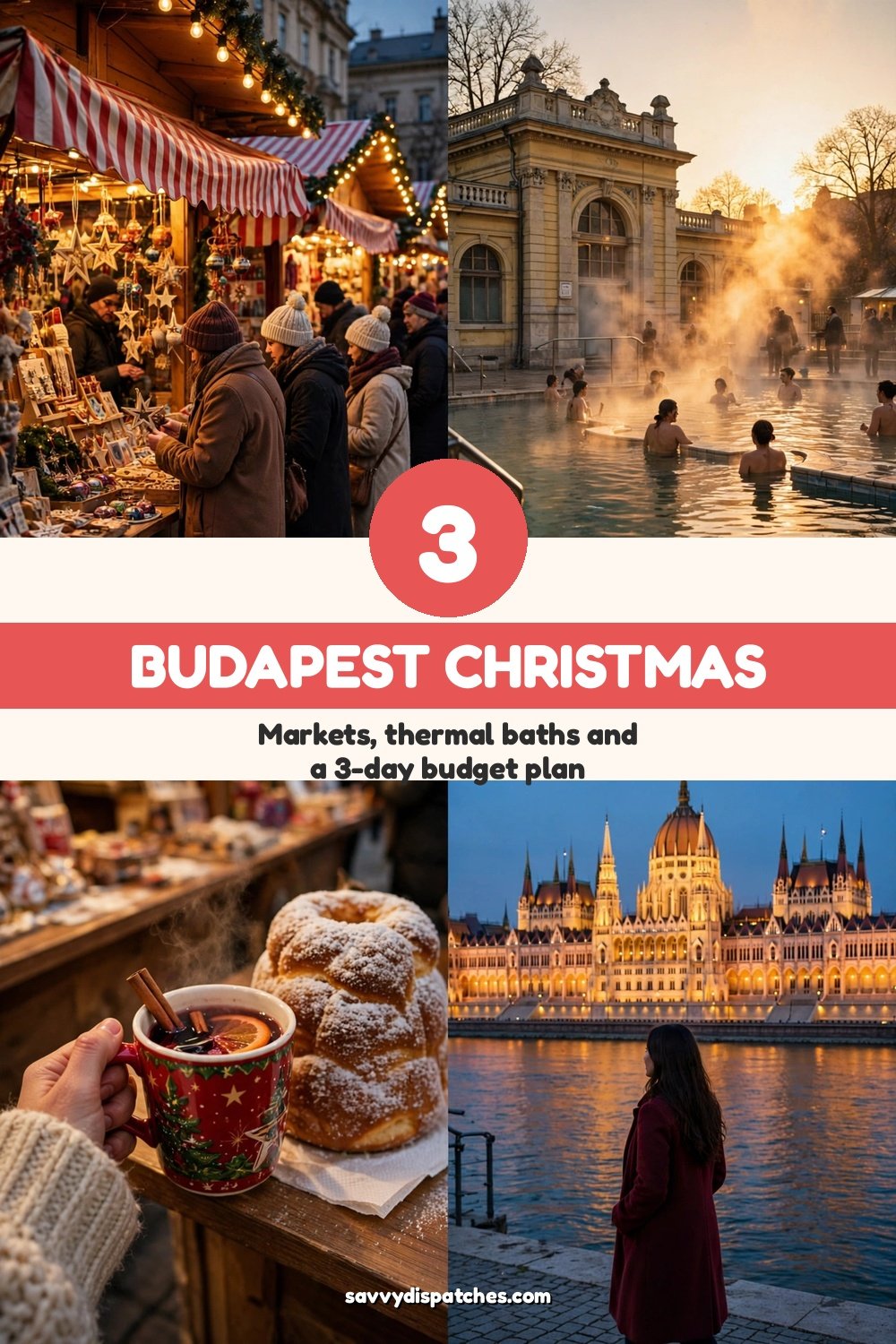
I went to Budapest in December because Vienna was too expensive, and I stayed because Budapest was better. The markets are free to enter, the mulled wine costs about 1,500 forints, and the light show on St Stephen’s Basilica runs every day from 17:30 for free. These are the Christmas markets in Budapest on a budget, with the 2026 dates, the real prices, and the 3-day itinerary I used. Both big markets opened on 13 November 2026, Advent Basilica runs to 1 January 2027, and Vorosmarty ter runs to 31 December. I spent three days there, ate at the market stalls, soaked in the thermal baths, and spent less than I expected to. If you want Christmas markets in Budapest without emptying your wallet, this is the one. For the wider Europe plan, my 13 best Christmas markets in Europe for first-timers has the dates for the other cities. Let’s get into it.
- Why Budapest Is the Best Budget Christmas Market City
- Advent Basilica: The Market to See First
- Vorosmarty Ter: The Classic Market
- Obuda and the Smaller Markets
- What to Eat and Drink at the Markets (With 2026 Prices)
- Budapest Christmas Budget: What 3 Days Actually Cost
- Thermal Baths: The Non-Market Hook
- Day 1: The Two Big Markets and the Light Show
- Day 2: Thermal Baths, the River, and Obuda
- Day 3: Slow Morning, Last Market, and the Ice Rink
- Where to Stay in Budapest in December
- Getting Around Budapest in Winter
- What to Pack and What to Skip
- You Might Also Like
Why Budapest Is the Best Budget Christmas Market City
Budapest beats Vienna on price and matches it on beauty. Entry to every outdoor market in the city is free, no tickets, no reservations. A cup of mulled wine costs about 1,500 forints, which is less than half what you pay in Vienna. The food stalls are cashless, so you pay by card or phone, and the markets offer a daily hot budget meal for 1,500 forints and a kids menu for 1,000. I ate lunch at the markets twice and spent less than I would on a single meal in Vienna.
The city is also easy. The two big markets sit a short walk apart in the centre, the metro is cheap, and the thermal baths give you a warm break when the cold bites. Stay three days, not two, because the third day is when the city slows down and shows you the quiet parts. For the budget method, my 13 cheapest countries to visit in 2026 has the daily budget method I use for every trip.
Local tip: Carry some forints as well as a card. The big stalls are cashless, but the small ones and the street vendors still take cash.
Advent Basilica: The Market to See First
Advent Basilica fills St Stephen’s Square in front of the basilica, and it is the prettiest market in Budapest. It opened 13 November 2026 and runs to 1 January 2027, open 11:00 to 22:00 Sunday to Thursday and 11:00 to 23:00 on Fridays and Saturdays. Entry is free. The square holds nearly a hundred craft and food stalls, a 12-metre tree, and an ice rink that circles it. After dark the basilica facade becomes a screen, with a free 3D light show every 30 minutes from 17:30.
Go at 17:30 for the first light show, then walk the stalls while the crowd is still watching the facade. The mulled wine costs 1,500 forints for a 300 ml cup, hot chocolate costs the same, and the souvenir ceramic mug costs 4,000 forints if you want to keep it. On 24 December the market runs 11:00 to 15:00, on 25 and 26 December 11:00 to 20:00, and on New Year’s Eve it stays open to 03:00.
Local tip: Be at the basilica at 17:30 for the first light show, then walk to Vorosmarty ter while the crowds are still watching the facade.
Vorosmarty Ter: The Classic Market
Vorosmarty ter is the older market, and it feels like it. The square fills with craft stalls, food chalets, and a big tree, and the whole place smells of cinnamon and grilled sausage. It opened 13 November 2026 and runs to 31 December, with the craft stalls running to 28 December. Entry is free. I went in the morning, when the stalls were just opening and the light was soft, and it was the calmest hour of the whole trip.
The food here is the classic Hungarian market food: langos with sour cream and cheese, grilled sausage, strudel, and chimney cake fresh off the spit. A plain langos costs about 2,400 forints, and a cup of mulled wine costs about 1,900 forints here, a little more than at the Basilica. Eat here for lunch, then walk to the Basilica for the evening light show, ten minutes away on foot.
Local tip: The craft stalls on the far side of the square, away from the metro exit, are quieter and the makers will talk to you about their work.
Obuda and the Smaller Markets
Obuda is the third market, and it is the local one. It opens 27 November 2026 in the old town across the river, and it is smaller, quieter, and cheaper than the two big markets. I went for an afternoon and it felt like a neighbourhood fair, not a tourist market. The stalls sell local crafts and food, the crowds are thin, and the prices are lower than in the centre.
Pair Obuda with a walk along the Danube and a stop at the Varoshaza Winter Park ice rink at Deak Ferenc Square, which opened 17 November 2026. The rink is outdoors, the skate hire is right there, and it is the best cheap evening in the city. Go on a weekday if you can, because the weekends fill fast.
Local tip: Obuda is best on a weekday afternoon, when the stalls are open, the light is soft, and you can actually talk to the vendors.
What to Eat and Drink at the Markets (With 2026 Prices)
Budapest market food is the best value in Europe. A cup of mulled wine costs 1,500 forints for 300 ml at the Basilica, hot tea costs 1,200, and hot chocolate costs 1,500. A plain langos costs about 2,400 forints, and the daily hot budget meal costs 1,500. The kids menu costs 1,000. I ate a full lunch at the markets for less than the price of a single main course in Vienna, and the food was better.
Order the classics. Kurtoskalacs, the chimney cake, is made fresh on a spit and dusted with cinnamon. Langos is fried dough with sour cream and cheese, and it is the best hot lunch in the cold. Retas, the strudel, comes filled with apple or cherry. For drinks, try the forralt bor, the Hungarian mulled wine, and the bombardino, a warm eggnog liqueur with brandy, which costs about 2,100 forints. If you want to eat cheap across Europe, my 10 grocery store meals for travelers looking to save money in Europe has the method I use for cheap eats on a city trip. For the food plan at home, my 12 travel-inspired recipes to make at home when you miss Europe has the dishes I tried to copy when I got back.
Local tip: Read the price board before you order. Prices change between stalls, and the board is the only price that counts.
Budapest Christmas Budget: What 3 Days Actually Cost
Budapest is cheap by European standards, but the markets can still eat your budget if you are not careful. Here is what three days cost me, per person, not counting flights. Stay in a flat or a small hotel in the centre, eat lunch at the markets, eat dinner at a local restaurant, and use the metro.
Hotel or flat: a mid-range stay in the centre runs a modest nightly rate in December, and booking early cuts it further. Food: budget around 6,000 to 8,000 forints a day if you eat lunch at the markets and dinner at a local place. Mulled wine: 1,500 forints a cup, so two cups a day is 3,000. Metro: a 72-hour travel card covers the whole trip. Thermal baths: a day ticket costs a moderate amount, and it is worth every forint. Total for three days, not counting flights, came to far less than a single weekend in Vienna. The euro is not used here, so pay in forints. One euro is about 400 forints. For the wider budget method, my 11 best budget travel destinations for 2026 has the daily budget breakdown I use on every trip.
Local tip: Buy the 72-hour travel card at the airport metro station on arrival. It covers the metro, the trams, and the buses, and it pays for itself by day two.
Thermal Baths: The Non-Market Hook
The thermal baths are the reason to stay a third day. Budapest sits on hot springs, and the outdoor pools steam in the cold air. I went on my second morning, when the air was freezing and the water was warm, and it was the best hour of the trip. The big baths are Szechenyi, with its yellow palace and outdoor pools, and Gellert, with its art nouveau halls. Both are open in December, and both are worth a visit.
Go in the morning, when the pools are quiet and the steam is thick. Bring a towel and flip-flops, or hire them there. Book a ticket online before you go, because the weekends sell out. Stay two hours, then walk to a cafe for lunch. The baths are the warm break that makes a cold December trip work.
Local tip: Szechenyi is best at opening time, when the outdoor pools are empty and the steam rises off the water in the cold air.
Day 1: The Two Big Markets and the Light Show
Arrive by midday if you can, drop your bags, and walk straight to Vorosmarty ter for lunch. Eat langos from a stall, drink a cup of mulled wine, and walk the craft stalls while the light is still good. The market is quietest at midday, and the food is freshest then. Spend two hours here, then walk ten minutes to St Stephen’s Square.
At the Basilica, walk the stalls in the afternoon, buy a chimney cake, and be in place at 17:30 for the first light show on the facade. Stay for the second show if you want, then eat dinner at a restaurant near the square. The square is at its best after dark, when the tree lights up and the whole place glows. End the day with a walk along the Danube, where the river reflects the lights.
Local tip: Do Vorosmarty ter first and the Basilica second. The light show is the evening event, and the morning market is the calm one.
Day 2: Thermal Baths, the River, and Obuda
Start day two at the thermal baths. Go at opening time, soak for two hours, and walk out warm into the cold morning. Eat a late breakfast at a cafe near the baths, then take the metro to the river. Walk the Danube promenade in the daylight, cross the Chain Bridge on foot, and climb to the Castle Hill for the view over the city.
In the afternoon, take the tram to Obuda for the local market. Walk the old town, eat at a stall, and stay for the lights. Obuda is quieter than the centre, and the evening there feels like a local secret. Come back to the centre for dinner at a ruin bar, which is the Budapest nightlife you came for, and end the night with a drink in the courtyard.
Local tip: The Chain Bridge is best walked at dusk, when the lights come on and the river goes dark below you.
Day 3: Slow Morning, Last Market, and the Ice Rink
Day three is the slow day. Sleep in, eat breakfast at a bakery, and walk the Jewish Quarter in the morning light. The streets are quiet, the shops are small, and the ruin bars are closed, so you see the neighbourhood as it really is. Buy gifts at the market stalls, not the souvenir shops, because the craft stalls sell the real thing.
In the afternoon, go back to the Basilica for a last walk through the stalls and a final cup of mulled wine. Then skate at the Varoshaza Winter Park rink at Deak Ferenc Square, which opened 17 November. The rink is outdoors, the skate hire is right there, and it is the best way to end a Budapest Christmas trip. Eat a last dinner near the square, and walk the river one more time before bed.
Local tip: Buy your gifts on day three, not day one. You will know what you actually want by then, and the craft stalls will still have the good pieces.
Where to Stay in Budapest in December
Stay in the centre, in District V or VII, so you can walk to both big markets. District V is the old centre, quiet and grand, and it sits right by the Basilica. District VII is the Jewish Quarter, livelier and cheaper, and it sits by the ruin bars and the restaurants. I stayed in District VII and walked everywhere. The metro runs late, and the trams run all night on the main lines. If you are travelling solo, my 11 affordable European destinations for solo female travelers has the safety and budget notes I use for city stays.
Book a flat with a kitchen if you can, because the grocery stores sell good food cheap and the markets cover lunch. Book early, because December fills fast, and the centre hotels double their prices in the last two weeks before Christmas. For the packing plan, my 35 carry-on packing tips has the cold-weather packing list I use for Budapest in December.
Local tip: Stay within a ten-minute walk of Deak Ferenc Square. It is the metro hub, the rink is there, and both big markets are a short walk away.
Getting Around Budapest in Winter
Budapest is easy to get around. The metro has four lines, the trams run everywhere, and the centre is walkable. Buy the 72-hour travel card at the airport metro station and use it for the whole trip. The airport bus drops you at Deak Ferenc Square, and the metro from there reaches every market in minutes.
Walk when you can. The centre is flat on the Pest side, and the markets are all within a twenty-minute walk of each other. Cross to Buda for the Castle Hill and the views, and take the funicular up if the climb looks steep. The trams along the Danube are the prettiest ride in the city, and they run all day. For the wider Europe train plan, my 9 Europe trip planning mistakes has the booking errors to avoid.
Local tip: Tram 2 along the Danube is the prettiest ride in the city, and it costs the same as any other tram, so ride it at dusk.
What to Pack and What to Skip
Pack warm and pack light. Budapest in December is cold, around freezing, and the wind off the Danube cuts through a thin coat. Bring a warm coat, a hat, gloves, and good shoes with grip, because the cobbles get icy. Bring layers, because the baths, the cafes, and the metro are all warm inside. Leave the heels at home, and leave the big bag too, because the markets are crowded and a big bag is a burden.
Skip the tourist menus near the markets. The restaurants on the side streets serve the same food for less, and the market stalls are the best lunch in the city. Skip the hop-on bus, because the centre is walkable and the metro is faster. Skip the expensive river cruise, because the Danube promenade walk is free and the view is the same. For the full packing list, my 35 carry-on packing tips has the cold-weather list I use.
Local tip: Pack a small day bag for the markets, not a big backpack. You need room for gloves, a scarf, and the chimney cake you will buy.
You Might Also Like
- 13 Best Christmas Markets in Europe for First-Timers (2026)
- 11 Best Christmas Markets in Germany (2026 Dates + 2-Week Train Itinerary)
- 11 Best Christmas Towns in Europe Worth the Trip (2026)
Local tip: Read the Europe markets guide first if you are adding a second city. It has the overlap window and the train plan that makes a two-city trip work.
