

I arrived in Marrakech at sunset, and the first thing I saw was the Koutoubia minaret glowing pink over the rooftops while the call to prayer rolled across the medina. By midnight I had eaten snails from a cart, haggled for a scarf I did not need, and watched snake charmers pack up their baskets in the square. That is Marrakech. It is loud, warm, and a little wild, and two or three days is the right amount of time to taste it without burning out. If you search for marrakech morocco things to do, you will find lists that read like they were copied from a guidebook. This list of marrakech morocco things to do is different. I built it from my own two trips, and every marrakech morocco things to do pick below has a real price, a real time, and a real mistake I made so you do not have to. Let’s get into it.
- Day 1 Morning: Start at Jemaa el-Fnaa and the Koutoubia in Marrakech
- Day 1 Midday: Get Lost in the Souks of Marrakech, Morocco
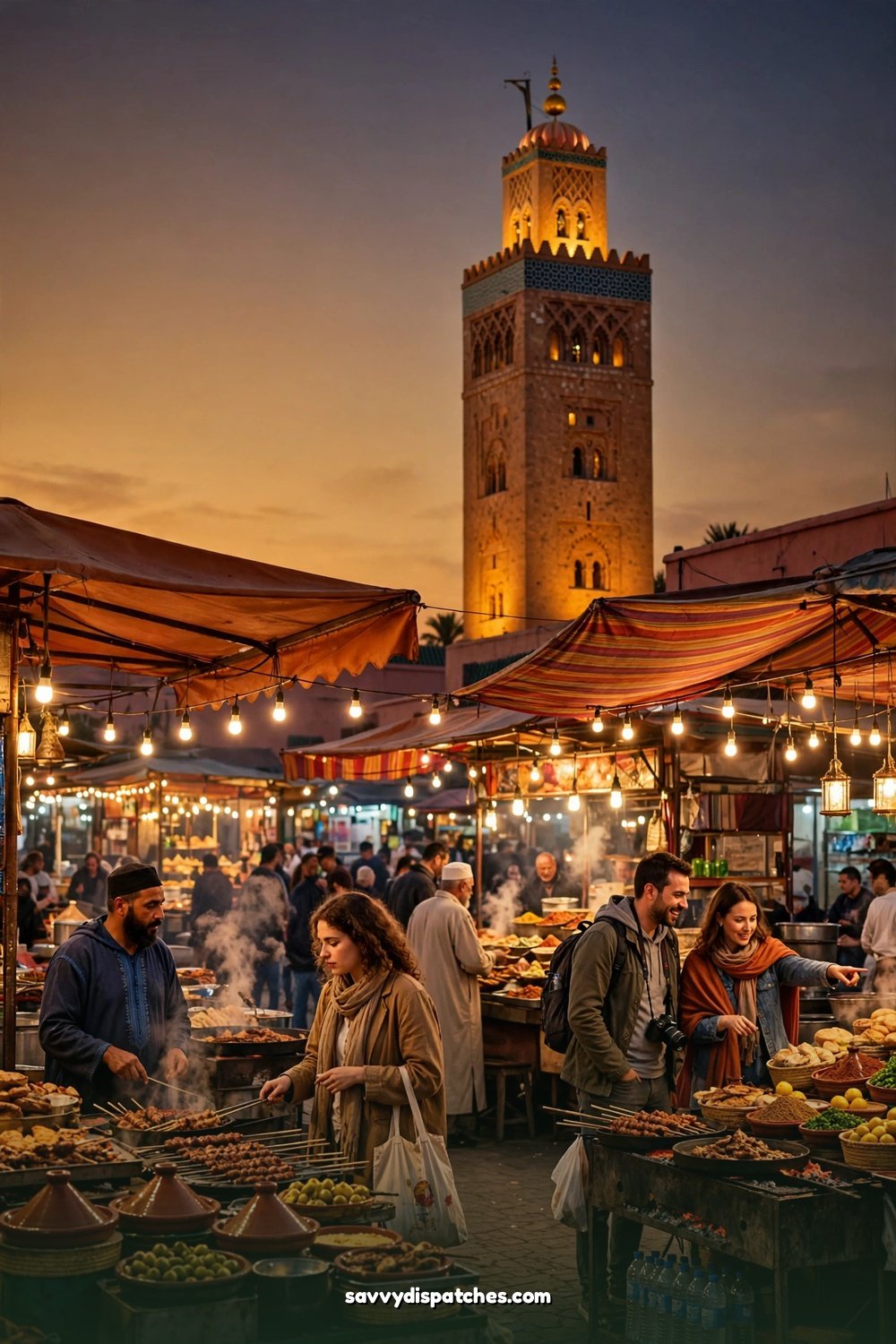
- Day 1 Evening: Eat at the Night Food Stalls in Jemaa el-Fnaa in Marrakech
- Day 2 Morning: Jardin Majorelle at Opening Time in Marrakech
- Day 2 Midday: Bahia Palace and the Saadian Tombs in Marrakech
- Day 2 Afternoon: Ben Youssef Medersa and the Secret Garden in Marrakech
- Day 2 Evening: Rooftop Dinner and a Hammam in Marrakech
- Day 3 Option A: Atlas Mountains and the Ourika Valley in Marrakech
- Day 3 Option B: Agafay Desert at Sunset in Marrakech
- Where to Stay in Marrakech for First-Timers
- What to Eat in Marrakech and What It Costs
- Getting Around Marrakech Without Getting Ripped Off
- Marrakech in 2 to 3 Days: A Simple Budget
- Quick Tips Before You Go to Marrakech
- You Might Also Like
Here is the shape of the trip. Day one stays in the medina: the square, the souks, and the food stalls after dark. On day two I cover the palaces and the garden, with a slow evening on a rooftop. For day three you choose: the Atlas Mountains, the Agafay desert, or a slow morning in the city. December is a fine time to come, with daytime highs near 20 degrees Celsius, nights near 7 degrees, and sunset around half past five. Pack a warm layer for the evenings. If you want the night-market side of the city first, my Marrakech night markets guide covers the food stalls in detail. And if Morocco is part of a bigger trip, my Fes to Marrakech route notes show how the two cities link up.
Day 1 Morning: Start at Jemaa el-Fnaa and the Koutoubia in Marrakech
Jemaa el-Fnaa is the big square at the heart of the medina, and it is free to walk. In the morning it feels calm: orange juice carts line the edges, shopkeepers open their shutters, and the Koutoubia minaret stands over it all. A glass of fresh orange juice costs 4 to 6 dirhams from a cart, and it is the best cheap breakfast in the city.
I start here because the square teaches you the rhythm of the city before you wander into the souks. Walk the edges, look up at the minaret, and get your bearings. The square changes completely after dark, so I come back in the evening for the second half of the show. Mornings are for watching, evenings are for eating.
Local tip: Buy your orange juice from a cart on the north side of the square, because the carts near the cafes charge double for the same glass.
Day 1 Midday: Get Lost in the Souks of Marrakech, Morocco
The souks run north from the square in a maze of covered lanes, and they sell everything: leather bags, spices, lamps, rugs, and silver. I give myself two hours with no destination, and I treat getting lost as the plan. A small leather pouch costs 30 to 50 dirhams after haggling, and a scarf runs 40 to 80 dirhams depending on the quality.
Haggling is part of the fun, and the rule is simple: offer half the first price, smile, and walk away slowly if the seller holds firm. They will call you back more often than not. I never pay the first price, and I never buy the first thing I like. The souks close for the midday prayer and reopen in the afternoon, so I plan a long lunch break around 1 in the afternoon.
Local tip: Learn the way back to the square by the spice smells, because the lanes all look the same and the smell of saffron and cumin marks the route home.
Day 1 Evening: Eat at the Night Food Stalls in Jemaa el-Fnaa in Marrakech
After dark the square fills with food stalls, smoke, and music, and this is the meal I plan my whole first day around. The stalls set up around 6 in the evening, and a full dinner of grilled meat, bread, and salad costs 40 to 70 dirhams. I pick a busy stall with a line of locals, point at what looks good, and sit on the bench with strangers.
Try the harira soup first, then the grilled kefta, then the mint tea that comes after. The stall owners will call out to you, and that is normal. Smile, keep walking, and pick the stall with the most smoke and the longest line. I eat here twice on every trip, and it never lets me down.
Local tip: Eat at the stalls in the middle rows, because the stalls on the outer edge pay the highest rent and charge more for the same plate.
Day 2 Morning: Jardin Majorelle at Opening Time in Marrakech
Jardin Majorelle opens at 8 in the morning, and I arrive at opening. A garden-only ticket costs 170 dirhams for a foreign adult, and the garden plus the Berber museum inside costs 230 dirhams. The combined ticket for all three sites, including the Yves Saint Laurent museum, costs 330 dirhams. Tickets sell online only, on the official ticket site, and nothing sells at the gate.
The garden is small, blue, and calm, with cacti, bamboo, and a cobalt-blue villa that photographs beautifully. Arrive early and the first hour is the quiet one, before the tour groups show up around 10. I walk the loop slowly, sit by the central pool, and leave by 9:30. The Yves Saint Laurent museum closes on Wednesdays, so I never plan this visit for a Wednesday.
Local tip: Book the 8 in the morning slot and head straight to the blue villa, because the light is soft, the paths are empty, and your photos will have no strangers in them.
Day 2 Midday: Bahia Palace and the Saadian Tombs in Marrakech
Bahia Palace costs 100 dirhams for a foreign adult and opens daily from 9 in the morning to 5 in the afternoon. The palace holds painted cedar ceilings, carved stucco arches, and quiet courtyards that feel like a different century. I go right at 9, when the light is soft and the crowds are thin, and I give it an hour.
The Saadian Tombs sit a short walk away and cost 100 dirhams as well, with the same 9 to 5 hours. Inside, the tombs hold the graves of sultans from the 1500s, and the chamber with the carved marble is the highlight. Both sites are run by the Ministry of Culture, and you can buy tickets at the gate or online. Restoration work from the 2023 earthquake is still going on, so some rooms may sit behind scaffolding.
Local tip: Visit the Bahia Palace first and the tombs second, because the tombs get crowded by midday and the palace absorbs a crowd better in the morning.
Day 2 Afternoon: Ben Youssef Medersa and the Secret Garden in Marrakech
Ben Youssef Medersa costs 50 dirhams for a foreign adult and stays open from 9 in the morning to 7 in the evening, later than the palaces. The old Quranic school holds a courtyard of carved cedar, marble, and tilework that stops people in their tracks. I spend 45 minutes here, mostly in the courtyard, looking up at the details.
After the medersa, I walk to the Secret Garden, a quiet walled garden a few minutes away, and I sit with a mint tea that costs about 20 dirhams. The garden is the calmest place in the medina, and it resets my head after the souks. If you want more on how I keep a trip like this cheap, my cheapest countries to visit in 2026 shows how Morocco fits a tight budget.
Local tip: Go to the medersa after 4 in the afternoon, because the tour groups leave, the light turns golden, and the courtyard feels like it belongs to you.
Day 2 Evening: Rooftop Dinner and a Hammam in Marrakech
Marrakech rooftops come alive at sunset, and I book a table for 6 in the evening so I can watch the sky change over the medina. A rooftop dinner with a tagine, bread, and mint tea costs 100 to 150 dirhams, and the view over the rooftops toward the Atlas Mountains is free with the meal. The call to prayer rolls across the city as the lights come on, and it is the best hour of the day.
After dinner, I book a hammam, the traditional steam bath. A basic public hammam costs 30 to 50 dirhams, and a private session with a scrub at a riad spa costs 200 to 350 dirhams. I take the private option after two days of walking, and the scrub leaves me feeling like a new person. Book ahead, because the good spas fill up in the evening.
Local tip: Pick a rooftop on the west side of the medina, because the sun sets over the rooftops there and the Koutoubia glows in the last light.
Day 3 Option A: Atlas Mountains and the Ourika Valley in Marrakech
If you have a third day, take it to the Atlas Mountains. A shared day trip to the Ourika Valley costs 150 to 300 dirhams per person, including transport and a guide, and it leaves around 9 in the morning. The drive runs about an hour into the foothills, where the air cools and the villages sit along the river. Your day includes a walk to the Setti Fatma waterfalls, a Berber village visit, and lunch by the river. Wear good shoes, because the waterfall path is rocky and steep in places. I take this option in winter, when the snow sits on the high peaks and the valley feels crisp and clear. Bring a warm layer, because the mountains run colder than the city by several degrees.
Local tip: Skip the waterfall climb if it rained the day before, because the rocks get slick and the guides will rush you past the best views.
Day 3 Option B: Agafay Desert at Sunset in Marrakech
The Agafay desert sits about 40 minutes from the city, and a sunset trip with dinner costs 300 to 500 dirhams per person. The desert is rocky, not sandy, with wide views and a big sky. I leave at 4 in the afternoon, ride a camel or a quad bike for an hour, and watch the sun drop behind the hills.
Dinner runs in a tented camp with music and tagine, and the stars come out fast once the sun goes down. It is the easiest desert experience near Marrakech, and it fits a half day. If you want the real Sahara, that needs three days and a longer drive, so I save it for a return trip. For more on planning a longer Morocco trip, my 10 days Morocco tour from Tangier shows the full route.
Local tip: Book the afternoon departure, not the morning one, because the desert is at its best in the last two hours of light and the morning trip misses it entirely.
Where to Stay in Marrakech for First-Timers
Stay in a riad inside the medina, close to Jemaa el-Fnaa. A good riad room costs 300 to 600 dirhams a night for two people, breakfast included, and the courtyard stays cool in the day and warm at night. I pick a riad within a ten-minute walk of the square, because the medina lanes get confusing after dark and a short walk home matters.
Hotels in the new town, called Gueliz, cost about the same but feel like any other city, with wide streets and chain hotels. The medina is the experience, so I stay there. Check that your riad offers airport pickup, because the lanes are hard to find at night and a driver who knows the door saves an hour of wandering.
Local tip: Ask your riad for a map photo on your phone before you leave, because the lanes have no street signs and a photo of the route home beats a paper map.
What to Eat in Marrakech and What It Costs
Moroccan food is cheap, filling, and everywhere. A tagine costs 40 to 70 dirhams at a local restaurant, harira soup runs 10 to 15 dirhams, and mint tea costs 8 to 15 dirhams. Breakfast at a riad usually means bread, olives, jam, and eggs, and it is included in the room price.
I eat lunch at the small restaurants near the souks, where the set menu costs 50 to 80 dirhams for three courses. Dinner goes to the square stalls or a rooftop. The food in the medina is better and cheaper than the food in Gueliz, and the same rule holds as everywhere: eat where the locals eat, not where the touts stand outside. If you like cooking what you eat on the road, my travel-inspired recipes from Europe show how I bring trip flavors home.
Local tip: Order the tagine of the day rather than the full menu, because it is the freshest dish in the kitchen and it arrives faster than anything else.
Getting Around Marrakech Without Getting Ripped Off
The medina is a walking city, and I cover most of it on foot. For longer trips, the small taxis called petit taxis run on meters, and a short ride inside the city usually costs 10 to 20 dirhams on the meter. Always ask for the meter before you get in, or agree on a price first. Drivers who refuse the meter are telling you the price will be high.
From the airport to the medina, the taxi costs around 70 to 100 dirhams, and the bus costs less. I take a taxi on arrival, when I have bags, and the bus on the way back when I know the route. Walking is free and it is how you find the city, so I plan my days on foot and use taxis only for the garden and the desert trips.
Local tip: Walk to the main road before hailing a taxi, because the cars waiting at the square charge tourist prices and the ones on the road run the meter.
Marrakech in 2 to 3 Days: A Simple Budget
Here is what a day in Marrakech costs me, per person, when I travel the way this guide describes. A riad room runs 150 to 300 dirhams per person per night when shared. Food costs 100 to 150 dirhams a day. Sights run 100 to 200 dirhams a day, depending on how many tickets you buy. Taxis and small rides add 20 to 40 dirhams. That puts a comfortable day at 370 to 690 dirhams, or roughly 35 to 65 dollars, before shopping and day trips.
| Item | Budget | Comfortable |
|---|---|---|
| Riad room (per person, shared) | 150 MAD | 300 MAD |
| Food and tea | 100 MAD | 150 MAD |
| Sights and tickets | 100 MAD | 200 MAD |
| Taxis and local rides | 20 MAD | 40 MAD |
| Daily total | 370 MAD | 690 MAD |
Day trips add 150 to 500 dirhams each, and shopping is whatever you decide it is. For more on stretching a travel budget, my best budget travel destinations for 2026 and my 10 days in Japan on a budget use the same daily math in very different places.
Local tip: Carry small notes and coins, because the souk stalls, the juice carts, and the taxis rarely have change for a 200-dirham note.
Quick Tips Before You Go to Marrakech
Book Jardin Majorelle tickets online before you fly, because nothing sells at the gate and the morning slots go first. Dress for a 13-degree swing between day and night, with a warm layer for evenings. Learn five words of French or Arabic, because a greeting in the local language changes every interaction in the souks. And carry cash, because the medina runs on dirhams and many small shops take no cards. If you want the packing habits that make a trip like this easy, my carry-on packing tips cover a warm layer in one bag, and my Europe trip planning mistakes apply to Morocco too, even though the city sits across the sea.
Marrakech in 2 to 3 days gives you the square, the souks, the palaces, and a taste of the mountains or the desert, and it leaves you wanting more. That is the right feeling. The city rewards the traveler who walks slowly, eats where the locals eat, and keeps one morning free for getting lost. Pick your third day, book the garden ticket, and let the city do the rest.
Local tip: Keep your last morning free with no plan, because the best hour I ever spent in Marrakech was an unplanned walk through the souks at opening time, before the crowds arrived.
You Might Also Like
If this guide helped, here are three more from my site. Read my Marrakech night markets guide for the food stalls after dark. Check my Fes to Marrakech route notes if you want to link the two cities. And save my 7-day Scotland Highlands trip under $1,500 for your next adventure.
