
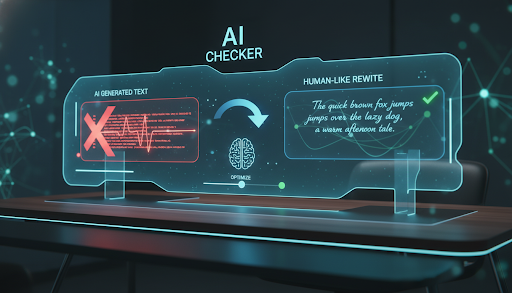
AI writing tools are no longer experimental. They sit inside real workflows, produce usable drafts, and save measurable time. The problem begins later, when managers review content that technically works but feels oddly interchangeable. Dechecker addresses that gap, not by slowing teams down, but by restoring judgment where automation quietly takes over.
- Why AI Content Becomes a Management Problem
- How Dechecker Fits Into Editorial Control
- Revising Strategically, Not Emotionally
- Humanizing Content Without Diluting Strategy
- Academic and Training Content Oversight
- Professional Documentation and Compliance
- SEO, Performance, and Managerial Metrics
- Integrating Dechecker Into Workflow
- Managing AI Writing With Intent
Why AI Content Becomes a Management Problem
Efficiency hides risk until review stage
From a management perspective, AI-generated text often passes initial checks. It is readable, grammatically clean, and aligned with briefs. The concern appears during approval, when multiple drafts start sounding alike or fail to reflect strategic nuance. This is usually when teams introduce an AI Checker into the review process, not to police usage, but to understand exposure.
Consistency versus credibility
Executives want consistency, but audiences expect intent. AI tends to flatten distinction in pursuit of balance. Over time, this erodes credibility even if metrics remain stable. Dechecker helps identify where uniformity crosses into sameness, giving managers leverage to intervene early.
Decision fatigue in content oversight
Reviewing AI-assisted content repeatedly drains attention. Managers skim instead of assess, trusting surface quality. Dechecker introduces objective signals that refocus attention on sections that actually require judgment, reducing cognitive load without lowering standards.
How Dechecker Fits Into Editorial Control
Detection as a governance layer
Dechecker works best when positioned as part of governance, not creation. The AI Checker provides probability-based insight into how content may be perceived, allowing managers to guide revision rather than rewrite themselves. Control remains centralized, effort distributed.
Understanding where AI dominates tone
AI influence rarely affects every paragraph equally. Introductions, summaries, and transitional sections usually carry the strongest signal. Dechecker surfaces these areas so teams can apply human review where it counts instead of spreading effort thinly.
Turning signals into policy
Over time, detection patterns inform internal guidelines. Teams learn which structures trigger higher AI likelihood and adjust drafting habits accordingly. Dechecker becomes a feedback mechanism, not a compliance threat.
Revising Strategically, Not Emotionally
Avoiding overcorrection cycles
One common managerial mistake is demanding complete rewrites after AI detection. This wastes time and frustrates teams. Dechecker enables targeted revision, focusing on tone shifts and phrasing choices rather than wholesale content replacement.
Maintaining author accountability
When writers understand that AI Checker results inform discussion rather than punishment, accountability improves. They engage with feedback instead of defending tools. The conversation shifts from “did you use AI” to “does this sound intentional.”
Preserving speed without sacrificing authority
Management rarely wants slower output. Dechecker supports fast drafting followed by deliberate refinement. Authority returns through selective edits, not extended timelines.
Humanizing Content Without Diluting Strategy
Where tone actually matters
Not every document needs warmth. Some require clarity, others conviction. Dechecker helps managers decide where human tone adds value and where neutrality is acceptable. This distinction prevents unnecessary stylistic changes.
Controlled use of rewriting tools
In sections that still feel mechanical after revision, applying the AI Humanizer allows teams to reshape expression without altering strategic intent. Used sparingly, it refines voice instead of masking it.
Balancing individuality with brand standards
Managers often struggle to allow personality without losing brand cohesion. Dechecker supports this balance by making tone deviations visible and adjustable rather than accidental.
Academic and Training Content Oversight
Institutional risk awareness
Universities and training departments face increasing scrutiny around AI usage. The issue is not adoption, but disclosure and perception. Dechecker gives administrators a way to assess content risk before external review.
Supporting learners without policing them
For educational managers, AI Checker results guide instruction rather than enforcement. Students learn how phrasing affects perception and adjust accordingly, strengthening writing skills instead of hiding tools.
Standardizing quality across contributors
Training materials often involve multiple authors. Dechecker helps maintain a consistent human tone across modules, reducing the patchwork effect common in AI-assisted documentation.
Professional Documentation and Compliance
Reports that carry responsibility
In regulated environments, language signals accountability. AI-like phrasing can appear evasive or generic. Dechecker helps compliance teams identify wording that weakens perceived responsibility before documents circulate.
Internal alignment through language
Strategy documents influence behavior. Overly sanitized language dampens urgency. Managers use AI Checker insights to reintroduce decisiveness where AI softened intent.
Reducing revision loops
Clear detection feedback shortens approval cycles. Instead of subjective disagreements, teams reference identifiable patterns and resolve them efficiently.
SEO, Performance, and Managerial Metrics
Engagement reflects leadership choices
Search performance increasingly mirrors user engagement. Content that feels generic loses traction regardless of optimization. Dechecker helps managers ensure that AI-assisted drafts still reflect deliberate messaging.
Structural uniformity as a hidden signal
AI favors predictable structures. Over time, this uniformity signals automation to both readers and algorithms. Dechecker highlights excessive regularity, allowing teams to vary structure intentionally.
Long-term content value
Managers think beyond publication. Content that reflects human judgment ages better, supports authority, and adapts to algorithm changes. Dechecker contributes to that resilience by promoting conscious revision.
Integrating Dechecker Into Workflow
Clear stages reduce friction
The most effective teams separate drafting, detection, and revision. Dechecker occupies the evaluation stage, creating clarity around responsibility. Writers draft freely. Managers decide what needs change.
Training through repetition
Repeated exposure to AI Checker feedback sharpens team intuition. Writers begin adjusting drafts proactively. Managerial oversight shifts from correction to confirmation.
Confidence in final approval
When detection results align with managerial judgment, approvals feel grounded. Decisions rely less on instinct and more on observable patterns, reducing hesitation at release.
Managing AI Writing With Intent
AI will remain part of professional writing. The managerial challenge is not controlling tools, but controlling outcomes. Dechecker offers a practical way to evaluate, adjust, and approve AI-assisted content without slowing operations or diluting strategy.
With AI Checker insights guiding revision and selective humanization restoring voice, managers regain control over tone, credibility, and long-term value—without stepping back into manual production.