35 Carry-On Packing Tips That Beat Every Airline Fee (2026)
I used to check a bag for every trip. Then a budget airline lost my checked luggage between Madrid and Lisbon on a four-day trip, handed me a £50 inconvenience voucher for a bag that turned up six days after I got home, and I have carried on only ever since.
- The Bag: What to Choose {#the-bag}
- The Packing System: How to Actually Fit Everything {#packing-system}
- Documents and Pre-Flight {#documents}
- Clothing Strategy: The Rule That Changes Everything {#clothing}
- Toiletries: What Gets Confiscated and What Doesn’t {#toiletries}
- Tech and Comfort {#tech-comfort}
- At the Airport: Avoiding the Fees {#at-airport}
- You Might Also Like
What changed was not just the bag — it was my entire packing system. These 35 carry-on packing tips are everything I have learned across trips to 30+ countries on one rolling carry-on and a personal item. They are specific, they are tested, and several of them will save you real money at check-in this year.
The carry-on packing list is the most-saved content format on Pinterest for a reason: people want the actual list, not the vague advice. Here it is.
TABLE OF CONTENTS
- The Bag: What to Choose
- The Packing System: How to Actually Fit Everything
- Documents and Pre-Flight
- Clothing Strategy: The Rule That Changes Everything
- Toiletries: What Gets Confiscated and What Doesn’t
- Tech and Comfort
- At the Airport: Avoiding the Fees
- The 35 Tips, Compiled
The Bag: What to Choose {#the-bag}
Tip 1: Know your airline’s carry-on dimensions before you buy a bag.
There is no universal carry-on size. Ryanair allows 55×40×20cm (40L). United allows 56×35×22cm. Turkish Airlines allows 55×40×23cm. A bag that fits Ryanair overhead bins is rejected at the gate by easyJet 30% of the time and vice versa. Check the specific airline’s page before every trip, not just when you buy the bag.
Tip 2: A 40L bag is the universal sweet spot.
40 litres fits within carry-on limits for nearly every airline including ultra-low-cost carriers. A 45L bag will be fine on most full-service airlines and get gate-checked on low-cost ones at peak hours. If you fly budget airlines more than twice a year, stay at or under 40L.
Tip 3: Soft-sided bags beat hard-shell for carry-on travel.
Hard-shell suitcases do not compress. A soft-sided duffel or backpack with a structured frame can be squished into an overhead bin that would reject a rigid case. The Osprey Farpoint 40 and the Away Flex bags are the two I have tested extensively. Both hold full trips.
Tip 4: Carry a personal item in addition to your carry-on — always.
Almost every airline allows a carry-on plus a personal item (under-seat bag). That personal item slot — typically 40×30×15cm — is where you pack your heaviest items on the day of travel: laptop, camera, water bottle, shoes. This is free weight that budget-airline baggage calculators do not count.
Local tip: At Ryanair and Wizz Air gates, staff occasionally measure bags if the overhead bins look full. Have your bag’s dimensions memorised and know which dimension to place against the sizer frame — most sizers are slightly generous on one axis.
The Packing System: How to Actually Fit Everything {#packing-system}
Tip 5: Use packing cubes — but only compression ones.
Standard packing cubes organise but do not compress. Compression cubes (eBags, Eagle Creek Specter) compress clothes to about 60% of their original volume by forcing out air when you zip the second outer layer. For a two-week trip in a 40L bag, the difference is significant.
Tip 6: Roll everything except structured items.
Rolling reduces wrinkles and takes less space than folding. Roll t-shirts, trousers, dresses, underwear, base layers. Fold structured shirts and blazers in thirds and lay flat on top. Stuffing shoes with socks uses every cubic centimetre inside the shoe.
Tip 7: Pack by outfit, not by item category.
Instead of packing all tops together and all bottoms together, pack each planned outfit together in a packing cube. This means you can access a full outfit without unpacking everything. It also forces you to confront that seven tops for a five-day trip is six too many.
Tip 8: Place heaviest items closest to the wheels.
When your bag is upright, heaviest items closest to the wheels (or in a backpack, closest to your back) balances the load and prevents tipping. Shoes, toiletry bag, and electronics go in last and sit at the bottom/back.
Tip 9: The 5-4-3-2-1 rule for a 10-day trip.
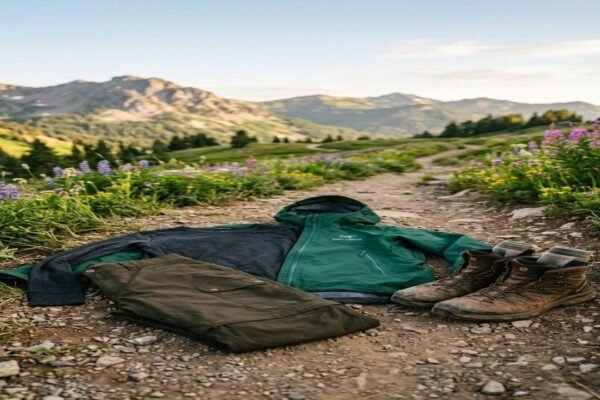
5 pairs of socks and underwear (wash mid-trip), 4 tops, 3 bottoms, 2 pairs of shoes (1 on feet), 1 jacket/layer. That is a complete 10-day carry-on trip with room for souvenirs on the way home.
Local tip: Put a luggage tag with your phone number on the outside of your carry-on even though it is not checked. If you leave it in an overhead bin and deplane, someone can call you immediately rather than the bag going to lost property.
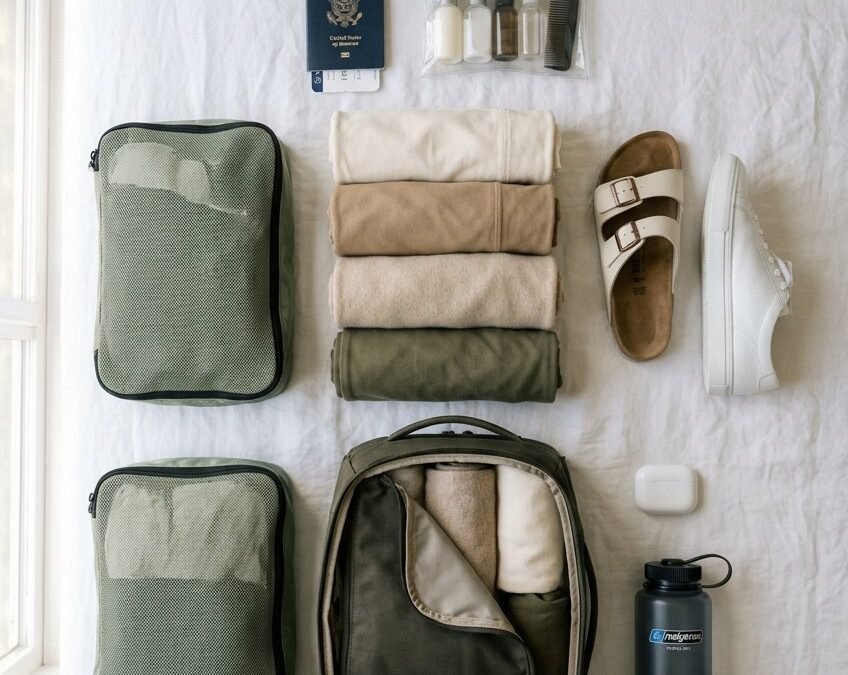
IMAGE PROMPT 1 — Packing flat lay:
GENERATE (paste into Gemini/Flow — no text, no blank zones):
Full-bleed 1080x1920px portrait 9:16. A top-down aerial flat lay on a clean white linen bed — a curated carry-on packing layout showing a compact 40L bag open beside neatly arranged piles of neutral travel clothing (rolled tees, folded trousers, a linen blazer), compression packing cubes in sage green, a passport, travel-size toiletry bottles, AirPods case, and sandals. Everything is arranged in a clean grid layout in warm natural window light. Top 30% of the frame shows the upper portion of the flat lay arrangement — a natural flat composition with no forced blank zone, soft shadows from window light. Subject fills the entire frame from a directly overhead angle. Sony A7IV 35mm macro equivalent, warm natural overhead light, clean neutral palette, film grain. Do NOT add text, boxes, or blank areas.
ADD OVERLAY IN IMAGE EDITOR AFTER GENERATING:
Category pill: “PACKING TIPS” — coral #E85555 background, white Fredoka caps
Headline: “35 Carry-On Rules That Work” — More Sugar script, white, cream backing
Accent line: “Beat every airline bag fee” — Fredoka Bold, coral, white box
Bottom: “savvydispatches.com” — small centered white text
IMAGE DESCRIPTION 1: A top-down flat lay of a complete carry-on packing layout — compression cubes, neutral rolled clothing, travel toiletries, passport, and sandals arranged in clean grid formation on a white linen bed. This is the entire system. 35 tips that make it work for trips up to two weeks, on any airline, without checking a bag.
Documents and Pre-Flight {#documents}
Tip 10: Screenshot everything before you lose signal.
Boarding passes, hotel confirmation numbers, transport bookings, entry visa QR codes — screenshot every document and save to a dedicated “trip documents” album in your phone camera roll. This is separate from having them in an email app. Screenshots work offline. Email requires signal.
Tip 11: Carry your passport in your personal item, not your carry-on.
Your personal item goes under the seat in front of you. Your carry-on goes in the overhead bin, sometimes four rows behind you. Any document you need for border control, customs, or connections goes in the personal item within reach.
Tip 12: Keep a digital and physical copy of your passport photo page.
Email yourself a scan of your passport’s photo page. Print a paper copy and keep it separate from your passport. If your passport is stolen abroad, the paper copy cuts the consulate replacement time from days to hours in most countries.
Tip 13: Check your passport expiry date right now.
Many countries (all EU states, Japan, USA) require at least 6 months validity on your passport beyond your travel dates. Ryanair and easyJet can deny boarding if you are flagged at check-in with less than 6 months remaining. Do not find this out at the gate.
Local tip: CLEAR and TSA PreCheck in the US, and UK Registered Traveller in the UK, both let you skip standard security queues and keep liquids/laptops in your bag. Annual cost: £70–$85. Pays for itself in saved time if you fly more than four times a year.
Clothing Strategy: The Rule That Changes Everything {#clothing}
Tip 14: The neutral palette rule.
Every item of clothing you pack should match at least two other items. Neutrals — navy, black, white, grey, tan, olive — create more outfit combinations from fewer pieces than any other colour strategy. One coral dress that matches nothing else in your bag wastes a slot.
Tip 15: One pair of shoes does almost all the work.
Most trips need: one comfortable walking shoe, one dressier option for evenings. That is two. On the plane, wear the bulkier pair. Pack the lighter pair. White leather sneakers and a simple sandal covers 90% of trip scenarios. Specialty shoes (hiking boots, heels, flipflops beyond sandals) come third and should be interrogated hard before they make the bag.
Tip 16: Merino wool is the carry-on traveler’s best material.
A Merino wool t-shirt can be worn three to four days before it smells. Cotton cannot. Synthetic moisture-wicking fabrics dry fast but accumulate odour faster than Merino. For a two-week carry-on trip, 3–4 Merino tops do the work of 7 cotton ones. Brands: Uniqlo (cheap, good quality), Icebreaker, Smartwool.
Tip 17: A silk sleep sack weighs 200g and replaces a pillow and a sheet.
If you are doing hostels, overnight trains, budget guesthouses, or flights longer than 6 hours, a silk or cotton sleep sack (£15–25, folded to fist-size) replaces a travel pillow, protects you from hostel bedding, and doubles as a light blanket on cold trains. One of the highest utility-to-weight ratios in any bag.
Tip 18: Pack one scarf that does five jobs.
A large lightweight scarf (linen, silk, or thin wool, roughly 90×170cm): modesty covering for temples and mosques, beach towel for a short swim, extra blanket on a cold flight, tied around your shoulders for evening when you only packed daytime clothes, and worn as a head covering in sun. Five functions, one item, 200g.
Tip 19: Do laundry mid-trip, not at the start.
Planning to do laundry on Day 5 of 10 means packing for 5 days, not 10. Most cities have laundromats (self-serve wash-and-dry in 90 minutes for $4–8). Most Airbnbs have a washing machine. Hotel laundry services charge 3× what a laundromat does — use the local one.
Tip 20: Never pack a full-size towel.
A travel towel (microfibre, quick-dry, 60×120cm) weighs 200g and compresses to the size of a thick paperback. A regular bath towel weighs 700g–1kg and takes up one-fifth of a 40L bag. If your accommodation provides towels, pack nothing. If it doesn’t, a travel towel is the answer. Not a beach towel. Not a regular towel.
Local tip: H&M and Zara across Europe sell basic t-shirts and underwear for €4–8 per item. On long trips, it is sometimes more efficient to buy a replacement item than to spend time at a laundromat — and give it away or recycle it before flying home to free up space.
Toiletries: What Gets Confiscated and What Doesn’t {#toiletries}
Tip 21: The 100ml rule still applies in Europe and the UK in 2026.
Despite many airports planning to update liquid scanners, the 100ml (per container, all containers must fit in one 1-litre clear bag) rule is still enforced at most European airports in 2026. Each liquid must fit the 100ml container limit. Check individual airport pages before travel for current rules.
Tip 22: Solid toiletries skip the liquid bag entirely.
Shampoo bars, conditioner bars, solid sunscreen, solid deodorant, solid perfume, toothpaste tablets — none of these count as liquids. They go in your regular bag, not the liquids bag, and weigh less than their liquid equivalents. Lush makes the most widely available range. For a trip over 5 days, switching at least shampoo and conditioner to bars frees up most of your liquids bag.
Tip 23: Decant into 30ml bottles, not 100ml bottles.
The TSA liquids rule allows 100ml bottles. But for most products (moisturiser, conditioner, foundation) you will never use 100ml on a 7-day trip. Decant into 30ml or 50ml bottles from your full-size product at home. You carry less weight, use your actual products, and leave room in the liquids bag.
Tip 24: Buy liquids at your destination, not at the airport.
Airport toiletries cost 40–80% more than the same item at a pharmacy or supermarket in the city. If you run out of something in Tokyo, a FamilyMart convenience store has it. In Rome, a farmacia has it. Avoid the airport pharmacy unless it is a genuine emergency.
Tip 25: Fragile cosmetics go in a glasses case, not loose.
Pressed powder, bronzer, and compacts that crack in transit: store them inside a rigid glasses case with a folded cloth buffer. This is the lowest-weight and lowest-cost solution to the problem that destroys more make-up than any other bag choice.
Local tip: A refillable perfume atomiser (£8–12, holds about 5ml, 6–8 sprays per ml) is the most space-efficient way to carry fragrance without the liquids bag taking a full slot. Fill it from your full-size bottle before you leave.
IMAGE PROMPT 2 — Toiletry flat lay:
GENERATE (paste into Gemini/Flow — no text, no blank zones):
Full-bleed 1080x1920px portrait 9:16. A top-down flat lay on a white marble bathroom countertop — a neatly arranged travel toiletry kit: clear TSA liquids bag with small labelled bottles, shampoo bar and conditioner bar in a tin, solid deodorant, bamboo toothbrush with toothpaste tablets in a small jar, mini skincare bottles in 30ml size, and a folded microfibre cloth. Everything looks clean and deliberate. Top 30% shows the top portion of the arrangement from directly above — white marble provides clean neutral context, natural window light creates soft shadow depth, no blank box. Sony A7IV 35mm overhead, cool white natural light, clean minimal aesthetic, film grain. Do NOT add text, boxes, or blank areas.
ADD OVERLAY IN IMAGE EDITOR AFTER GENERATING:
Category pill: “PACKING TIPS” — coral #E85555 background, white Fredoka caps
Headline: “Solid Toiletries Save Your Liquids Bag” — More Sugar script, white, cream backing
Accent line: “35-tip carry-on packing system” — Fredoka Bold, coral, white box
Bottom: “savvydispatches.com” — small centered white text
IMAGE DESCRIPTION 2: A clean flat lay of a complete travel toiletry kit on white marble — solid shampoo bar, toothpaste tablets, 30ml decant bottles, a TSA liquids bag, and a bamboo toothbrush. Switching to solid toiletries skips the liquids bag almost entirely and cuts the weight and bulk from your carry-on by a third on longer trips.
Tech and Comfort {#tech-comfort}
Tip 26: One universal power adapter, not country-specific ones.
A universal travel adapter (one plug, multiple input formats, 2–4 USB slots) covers every country for £15–25. Do not pack separate UK, EU, and US plug adapters. One brick, one slot in the bag, every country covered.
Tip 27: Noise-cancelling earbuds are the single best flight purchase you will ever make.
AirPods Pro or Sony WF-1000XM5 (the Sony are better at noise cancellation for the price) change long-haul flights from an exercise in endurance to something manageable. They also work in loud hostels, overnight trains, and any crowded transport situation. Budget version: Anker Soundcore Q45 at £50 does 80% of the job.
Tip 28: Download offline maps before every trip.
Google Maps offline map downloads work for navigation without signal. Maps.me has more hiking trail and rural road data. Download both, set the region to the country or region you are visiting, do it on Wi-Fi before you leave. This costs nothing and saves you expensive roaming data in remote areas.
Tip 29: A power bank with a minimum 10,000mAh charge is non-negotiable.
A dead phone is a useless boarding pass, an inaccessible hotel booking, an inoperable navigation system, and an unusable emergency contact system. A 10,000mAh power bank (Anker PowerCore or equivalent) fits in a pocket, costs £20–30, and recharges a phone 2–3 times. Pack it in your personal item, not your carry-on — power banks must stay with you, not in hold luggage.
Tip 30: An eye mask and earplugs together weigh 30g and cost £3.
Not the noise-cancelling earbuds — basic foam earplugs for sleeping. Dorm rooms, overnight buses, early morning construction outside a hotel window. These two items together cost less than one bad night of sleep.
Tip 31: A dry bag (5L) inside your bag protects electronics from rain.
A 5-litre roll-top dry bag from any outdoor shop costs £5–8 and weighs 80g. Put your phone, passport, and wallet inside it when you are hiking, on a boat, caught in sudden rain, or anywhere near water. Insurance against the thing that ruins trips.
Local tip: Google Fi (US customers) and Airalo eSIM (international) both sell prepaid data plans that activate before you leave home and work in multiple countries on one plan. For trips covering multiple countries, they are cheaper than buying individual SIMs per country.
At the Airport: Avoiding the Fees {#at-airport}
Tip 32: Weigh your bag at home before you leave, not at check-in.
A kitchen scale or luggage scale (£8 on Amazon) saves you from the worst moment in travel: discovering your “carry-on” is over the limit at the gate with £60 in forced checked bag fees waiting. Most carry-on weight limits are 7–10kg on low-cost airlines and 12–15kg on full-service. Know yours.
Tip 33: Wear your heaviest items through security, not inside your bag.
Heaviest shoes on your feet. Heaviest jacket on your body. Laptop in your hands to go through the scanner tray. A 200g difference in bag weight is meaningless in a store. At an airline weight check with a strict 7kg limit, it is the difference between a fine and a free flight.
Tip 34: Gate-check only as a last resort — and always keep your personal item.
If the overhead bins fill and cabin crew ask to gate-check your carry-on, do it only if the alternative is holding up boarding. But always pull out your laptop, passport, medication, and anything fragile or irreplaceable before you hand it over. Gate-checked bags go to the hold. They are not handled gently.
Tip 35: The best carry-on packing trick nobody tells you: leave 20% of your bag empty.
A bag packed to 100% capacity has no room for souvenirs, purchases, or the extra layer you needed and bought. A bag packed to 80% capacity is also easier to open, close, and access in an overhead bin without half your clothes spilling into the aisle. Pack less than you think you need. You will almost always use less than you think.
Local tip: If you are connecting through a hub airport (Heathrow, Charles de Gaulle, Amsterdam Schiphol) and your connection is under 90 minutes, carry all documents, medications, and anything valuable in your personal item. If you miss a connection and your carry-on is gate-checked, you may be separated from it until the next flight.
IMAGE PROMPT 3 — At the airport with carry-on:
GENERATE (paste into Gemini/Flow — no text, no blank zones):
Full-bleed 1080x1920px portrait 9:16. A woman in a neutral linen outfit walks confidently through a bright modern airport terminal pulling a compact soft-sided 40L rolling carry-on bag beside her, a small canvas backpack on one shoulder as her personal item. Natural light floods from tall terminal windows above. Other travellers visible in soft focus in the background, moving in the same direction. Top 30% of frame shows the bright airy airport roof structure and natural daylight from tall glass windows — warm morning light creates a naturally bright and airy zone at top, no blank box. Subject in lower 60%. Sony A7IV 50mm, warm morning airport light, clean modern aesthetic, film grain. Do NOT add text, boxes, or blank areas.
ADD OVERLAY IN IMAGE EDITOR AFTER GENERATING:
Category pill: “CARRY-ON TRAVEL” — coral #E85555 background, white Fredoka caps
Headline: “One Bag. Zero Check-In Fees.” — More Sugar script, white, cream backing
Accent line: “35-tip packing system inside” — Fredoka Bold, coral, white box
Bottom: “savvydispatches.com” — small centered white text
IMAGE DESCRIPTION 3: A traveler strides through a bright airport terminal pulling a compact carry-on with a canvas backpack over one shoulder — two-bag carry-on system, no checked bag, no fee. This is what two weeks of travel looks like when you have a system. 35 packing tips that make it reliable enough to do every trip, every airline, without anxiety at the gate.
You Might Also Like
- 13 Cabin Trip Outfit Ideas for Women: What to Actually Pack — specific packing for a weekend getaway
- 15 Trekking Outfits for Women That Actually Work on Hard Trails — packing for hiking trips
- 9 Europe Trip Planning Mistakes That Waste Money — the logistics mistakes that actually cost money
1280x720px landscape, no text — a traveler walking through a bright modern airport terminal with a compact carry-on bag and backpack, natural terminal light, warm morning tones, other travelers in soft-focus background. Blog display only.