
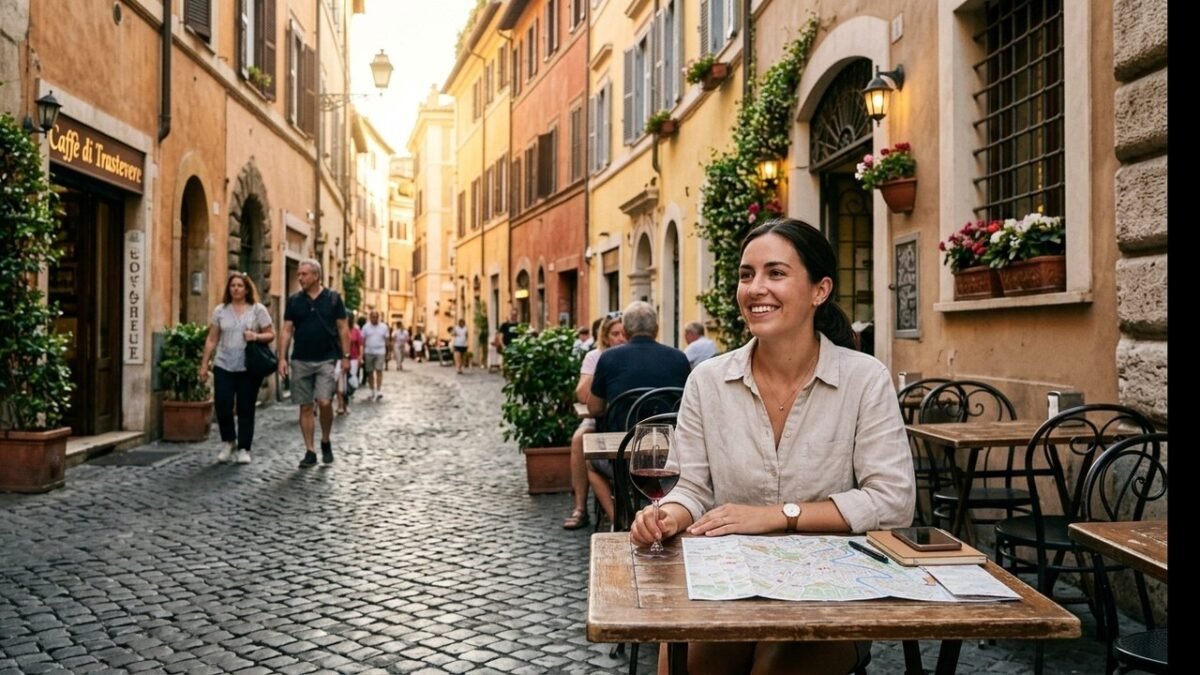
On my first trip to Europe, I spent $450 in three days on things that gave me zero joy. I paid thirty euros for two limp panini and warm sodas next to the Colosseum, handed fifty dollars to an airport currency exchange booth in London, and paid an eighty-euro luggage penalty at a budget airline gate because my backpack wheels stuck out two inches past the metal sizer bin.
- The Hidden Economics of Planning a European Trip
- 1. Booking High-Speed Trains on the Day of Travel
- 2. Exchanging Currency at Airport Kiosks and Tourist Booths
- 3. Dining Directly on Historic Plazas and Landmark Steps
- 4. Falling into Budget Airline Carry-On Baggage Traps
- 5. Scheduling Your Trip Exclusively for July and August
- 6. Buying Multi-Day City Sightseeing Passes Without Doing the Math
- 7. Taking Airport Taxis Instead of Dedicated Express Rail Links
- 8. Moving Cities Every 48 Hours Instead of Base-Hubbing
- 9. Ignoring Regional Restaurant Table Fees and Bread Basket Charges
- The 3 Booking Habits That Save $1,000 on Every Trip
I thought I was being thrifty because I booked a cheap flight. In reality, I was bleeding money through hidden travel leaks that every first-timer falls into.
Europe does not have to be expensive. In fact, if you know how local transit pricing, grocery markets, and regional booking calendars actually function, traveling in Europe can cost less per day than living in a major US or UK city.
After visiting twenty-four European countries and tracking thousands of dollars in travel receipts, I compiled the nine most common, expensive Europe trip planning mistakes travelers make, and the exact strategies to avoid them.
The most expensive Europe trip planning mistakes happen after flights and hotels are already booked. Booking high-speed rail on the day of travel, using predatory airport currency exchange kiosks, eating at historic plaza cafes with hidden cover charges, and flying budget airlines without measuring carry-on dimensions can add $500 to $1,200 in unnecessary fees. Booking trains 60 to 90 days out, using bank-vestibule ATMs, and base-hubbing saves substantial money.
The Hidden Economics of Planning a European Trip
Rules to plug hidden vacation leaks
-
✓
Book high-speed rail 60 to 90 days ahead: Dynamic pricing jumps walk-up fares on Frecciarossa, TGV, and Eurostar from €19 to €70+. Lock in early Super Economy or Prem’s fares for major intercity legs. -
✓
Use bank-vestibule ATMs and decline dynamic conversion: Avoid airport currency booths and standalone Euronet kiosks. Withdraw cash from official bank branch ATMs and always choose to be billed in local currency (EUR/GBP). -
✓
Base-hub instead of moving every 48 hours: Relocating cities every two days doubles your transit costs, locker fees, and dining premiums. Stay 4 to 6 nights in one central hub and take inexpensive regional day trips.
Most travelers focus exclusively on finding cheap flights and affordable accommodations. While those two categories make up the foundation of your budget, your daily operational spending dictates if your trip stays under budget or leaves you in debt.
Europe’s travel industry is sophisticated. Tourist infrastructure is designed to extract convenience fees from travelers who fail to plan ahead. A train ticket that costs fifteen euros when booked two months in advance jumps to eighty euros on the morning of departure. A meal eaten fifty meters down an alley costs half what a tourist bistro charges across from a cathedral.
Plugging these nine financial leaks will easily save you between $500 and $1,200 over a two-week European vacation without downgrading the quality of your trip.
Download the official national rail apps (like SNCF Connect for France, Trenitalia for Italy, and Deutsche Bahn for Germany) rather than booking exclusively through third-party aggregator sites, which tack on booking commissions and booking change fees.
1. Booking High-Speed Trains on the Day of Travel
The single biggest mistake budget travelers make in Western and Southern Europe is treating high-speed rail like a local subway where prices stay flat.
In countries like France, Italy, Spain, and the United Kingdom, high-speed rail systems operate on dynamic airline-style pricing models. A high-speed Frecciarossa ticket from Rome to Florence might cost nineteen euros if purchased sixty days ahead of time. Walk up to the station ticket kiosk thirty minutes before departure on a Tuesday morning, and that exact same second-class seat costs fifty-five to seventy euros.
If you are taking five train legs across a two-week trip, buying tickets walk-up easily adds $250 to $400 in unnecessary transport surcharges to your vacation total.
What to do instead: Map out your major intercity travel dates six to ten weeks before your departure date. National rail carriers open ticket bookings sixty to ninety days in advance. Lock in non-refundable Super Economy or Prem’s fares for long-distance routes, and save walk-up ticket purchases strictly for slow regional commuter lines where prices remain fixed by law.
In Italy, both state-run Trenitalia and private high-speed operator Italo run identical high-speed routes between Rome, Florence, Venice, and Milan. Compare prices across both operators before purchasing, as Italo frequently runs 30 percent discount flash sales on Tuesdays.
2. Exchanging Currency at Airport Kiosks and Tourist Booths
Stepping off an international flight and walking up to an airport Travelex or Euronet currency exchange window is the quickest way to lose fifteen to twenty percent of your travel money before you even reach your hotel.
These airport exchange kiosks advertise “Zero Percent Commission” in bold neon letters. What they hide in tiny print is a predatory foreign exchange spread. If the true market rate is 1.10 dollars per euro, they will sell you euros at 1.25 or 1.30, pocketing fifteen to twenty cents on every single dollar you trade.
What to do instead: Set up a checking account that charges zero foreign transaction fees and reimburses international ATM withdrawal surcharges (such as Charles Schwab, Capital One, or digital banks like Wise and Revolut). When you land in Europe, bypass the exchange desks entirely. Walk up to an official, bank-operated ATM located inside a bank branch vestibule (look for major names like BNP Paribas, Santander, or Deutsche Bank) and withdraw local currency at the true interbank exchange rate.
When using an overseas ATM or paying by credit card at a store terminal, the machine will ask if you want to be charged in US Dollars or the local currency (Euros, Pounds, etc.). Always choose to be charged in the local currency. Choosing US Dollars triggers dynamic currency conversion, allowing the local machine to charge a hidden 5 to 10 percent conversion fee.
3. Dining Directly on Historic Plazas and Landmark Steps
There is an undeniable allure to sitting outside at a cafe overlooking St. Mark’s Square in Venice, the Colosseum in Rome, or the Eiffel Tower in Paris. But dining on the perimeter of world-famous monuments comes with an eye-watering price tag for subpar food.
Restaurants occupying prime tourist plaza real estate pay astronomical commercial rents. To survive, they rely on one-time tourist foot traffic rather than repeat local diners. The result is often thawed, factory-prepared food, indifferent service, and prices that are three to four times higher than authentic neighborhood trattorias. A simple espresso that costs 1.50 euros at a neighborhood bar counter can cost fourteen euros when ordered at an outdoor table on Piazza San Marco.
What to do instead: Adopt the “Two-Street Rule.” Walk at least two to three blocks away from any major cathedral, museum entrance, or famous plaza. Look for quiet side alleys with small chalkboards displaying handwritten menus in the local language, paper tablecloths, and dining rooms filled with local office workers or residents. You will enjoy fresher, authentic regional food for a fraction of the cost.
In Italy, standing at the bar counter (al banco) to drink your morning espresso and eat a fresh cornetto pastry costs less than half the price of sitting down at a table (al tavolo) where table service fees are automatically added to your bill.
4. Falling into Budget Airline Carry-On Baggage Traps
European ultra-low-cost carriers like Ryanair, Wizz Air, and EasyJet advertise flights across Europe for fifteen to thirty euros. But their business model relies heavily on charging steep penalties for baggage violations at the boarding gate.
Many travelers buy a base ticket without reading the strict baggage dimensions. In 2026, a standard ultra-low-cost ticket includes only one small personal item that must fit entirely under the seat in front of you (roughly 40 x 20 x 25 centimeters). If your bag exceeds those dimensions by even an inch, gate agents will force you to place your bag in the metal sizer bin and charge an on-the-spot airport baggage fee of fifty to seventy euros per flight leg.
If you fly three budget routes across your vacation, baggage gate fees can easily exceed the cost of the plane tickets themselves.
What to do instead: If you plan to travel with a standard carry-on rolling suitcase or a large 40-liter backpack, pay for “Priority and 2 Cabin Bags” online during your initial flight booking. Adding cabin baggage during online check-in typically costs ten to twenty euros, compared to paying seventy euros at the airport boarding gate. Better yet, pack ultra-light using a dedicated 30-liter under-seat travel pack that complies with free personal item allowances.
Wear your bulkiest clothing items (such as your heavy trail boots, fleece pullover, and waterproof shell jacket) while boarding the aircraft. Stashing heavy items on your body frees up precious space and weight inside your carry-on bag.
5. Scheduling Your Trip Exclusively for July and August
Visiting Europe during peak midsummer seems natural for summer vacation calendars. However, July and August present the worst combination of peak accommodation prices, oppressive heatwaves, and overwhelming crowds.
During high summer, hotel and vacation rental rates in popular hubs like the Amalfi Coast, Santorini, Dubrovnik, and Paris climb 50 to 100 percent above shoulder season levels. You will spend hours standing in midday heat for cathedral entrances, face crowded trails, and encounter exhausted hospitality staff. Furthermore, across countries like France and Italy, many independent family-run bakeries, butchers, and local bistros shut down completely for two to three weeks in August for annual summer holidays.
What to do instead: Shift your travel window to the shoulder seasons: late April through early June, or September through late October. During shoulder months, temperatures are pleasant for walking, crowds drop by half, and boutique hotels drop their rates significantly. The experience feels authentic, relaxed, and affordable.
September and early October are widely considered the golden months for European travel. Sea waters in the Mediterranean remain warm from summer sun, harvest festivals take place across wine regions, and lodging prices drop 30 to 40 percent compared to July.
6. Buying Multi-Day City Sightseeing Passes Without Doing the Math
City tourism boards heavily promote 48-hour and 72-hour tourist passes (like the Paris Pass, Rome Pass, or London Pass) promising unlimited sightseeing and massive savings.
For a small minority of travelers who plan to run through five major museums every single day from 8am to 6pm, these passes can offer value. But for the vast majority of travelers, buying an $80 to $150 multi-day tourist card results in spending more money than paying individual entry fees.
Most travelers overestimate how many museums they can realistically absorb in a single day before museum fatigue sets in. Furthermore, many of Europe’s finest experiences (wandering cobblestone neighborhoods, exploring public parks, visiting ancient churches, and walking historic riverbanks) are completely free.
What to do instead: List the top three monuments or museums you genuinely care about visiting in a city. Check their individual admission ticket prices online. In many cases, three individual tickets cost forty to fifty euros total, rendering an eighty-euro multi-day city tourist pass an unnecessary expense.
Many European state-run museums offer free admission on the first Sunday of every month (including the Louvre in Paris during off-season months, and state museums in Florence and Rome). Check museum websites before booking your calendar dates.
7. Taking Airport Taxis Instead of Dedicated Express Rail Links
Save this for later on Pinterest!
Follow us for more honest budget travel guides: @savydispatches on Pinterest
After an eight-hour flight, stepping into an airport taxi queue feels convenient. But taking a private cab from distant international airports into city centers is an expensive habit that rarely saves time during rush hour traffic.
A private taxi from Paris Charles de Gaulle into central Paris costs a fixed flat fare of 56 to 65 euros. From Rome Fiumicino, a taxi costs fifty euros. From London Heathrow, a black cab into central London can easily top 90 to 120 British pounds.
What to do instead: European airports are connected to city centers via dedicated express rail links, regional commuter trains, and express airport coaches. The RER B train from Paris CDG into central Paris costs roughly twelve euros and avoids highway gridlock. The Leonardo Express from Rome Fiumicino to Roma Termini costs fourteen euros and arrives in thirty-two minutes flat. In London, the Elizabeth Line connects Heathrow directly to central London in thirty-five minutes for under thirteen pounds.
Taking public airport transit cuts your arrival transport cost by 70 to 80 percent while delivering you straight to major central subway connections.
If you are traveling as a group of three or four people with shared luggage, a flat-rate airport taxi can occasionally match the combined cost of four individual express train tickets. Always compare the total group fare against individual train tickets before deciding.
8. Moving Cities Every 48 Hours Instead of Base-Hubbing
An ambitious itinerary that visits London, Paris, Amsterdam, Berlin, and Prague in ten days looks impressive on social media. In reality, it is one of the most exhausting and expensive ways to travel.
Moving to a new city every two days creates hidden expenses: intercity train or flight tickets every forty-eight hours, local transit tickets to and from stations, luggage storage fees while waiting for apartment check-in times, and the loss of half-day travel windows spent packing and waiting on platforms. Furthermore, changing hotels every two nights prevents you from negotiating weekly lodging discounts or shopping for groceries.
What to do instead: Embrace the “Hub and Spoke” travel model. Pick one central base city and book a comfortable apartment or guesthouse for five to seven nights. Take affordable 30-minute day trips by regional rail to nearby historic towns, castles, and coastal villages without packing your bags or changing beds.
Staying in one base secures weekly accommodation discounts of 10 to 20 percent, saves hundreds of dollars on long-distance transit, and allows you to develop a genuine rhythm with local neighborhoods.
In countries like Belgium and Switzerland, regional day-return train tickets bought on weekends are heavily discounted. In Belgium, weekend rail tickets are 50 percent off between any two stations in the country.
9. Ignoring Regional Restaurant Table Fees and Bread Basket Charges
Dining etiquette and bill line items vary significantly across European borders. Travelers who do not understand local dining rules often feel cheated when the final check arrives with unexpected charges.
In Italy, almost every sit-down restaurant charges a “coperto” (cover charge) ranging from two to five euros per person. This is not a scam; it is a legal, traditional fee that covers linen tablecloths, bread, and table setting. In Portugal, waitstaff often place small dishes of olives, cheese, and fresh bread on your table unprompted before your meal. Unlike in the US where chips or bread might be complimentary, in Portugal, if you eat from those dishes, they will be billed individually to your tab.
Similarly, ordering still or sparkling bottled water in European restaurants costs three to five euros per bottle, which quickly adds twenty dollars to a family dinner if you order multiple rounds.
What to do instead: Read the bottom of restaurant menus to verify cover charges before ordering. If you are in Portugal and do not want the appetizers placed on your table, politely say “no thank you” immediately and the waiter will remove them without billing you. In France and the UK, ask specifically for a carafe of tap water (“une carafe d’eau” in France) which is clean, delicious, and legally required to be served for free.
Tipping customs in Europe are modest compared to North America. In most European countries, leaving a ten to twenty percent tip is unnecessary. Simply rounding up your bill by a couple of euros or leaving five to ten percent for exceptional service is the local standard.
The 3 Booking Habits That Save $1,000 on Every Trip
Mastering European budget travel comes down to three disciplined habits:
First, book your transport in the correct order. Reserve long-distance high-speed trains two months in advance, book intercity coaches for secondary routes, and use regional trains for flexible day trips.
Second, separate your meals into two budget tiers. Eat breakfast and trail lunches from local bakeries and supermarkets, and spend your dining funds on cozy sit-down dinners at neighborhood family bistros away from tourist monuments.
Third, pack light enough to stay mobile. Avoiding checked luggage fees and moving with ease on public transit saves you money, time, and physical strain on every single leg of your trip.
Keep a digital photo of your passport, travel insurance policy, and credit card customer service numbers saved in an offline encrypted folder on your phone. Having instant access to vital documents solves travel disruptions quickly without costly international phone roaming calls.