

I went to Brussels for the chocolate and stayed for the light show at the Brussels Christmas markets. The Brussels Christmas markets are not one market but a whole city centre taken over: more than 200 wooden chalets strung across six squares, a 55-metre Ferris wheel, an ice rink, and a nightly sound-and-light show on the Grand-Place. This is the Brussels Christmas markets guide: the 2026 dates, the hours, and the square-by-square walking route I used. Winter Wonders, the 25th edition, opens Friday 27 November 2026 and runs to Sunday 3 January 2027, daily 12:00 to 22:00, and entry is free. The Brussels Christmas markets are the easiest Christmas trip I have done: the whole route is flat, walkable, and free to enter. My 13 best Christmas markets in Europe for first-timers has the dates for the other cities, and my Vienna in December guide is the grander twin to this trip.
- Why the Brussels Christmas Markets Are Worth the Trip in 2026
- Brussels Christmas Markets 2026: Dates, Hours and the Six Squares
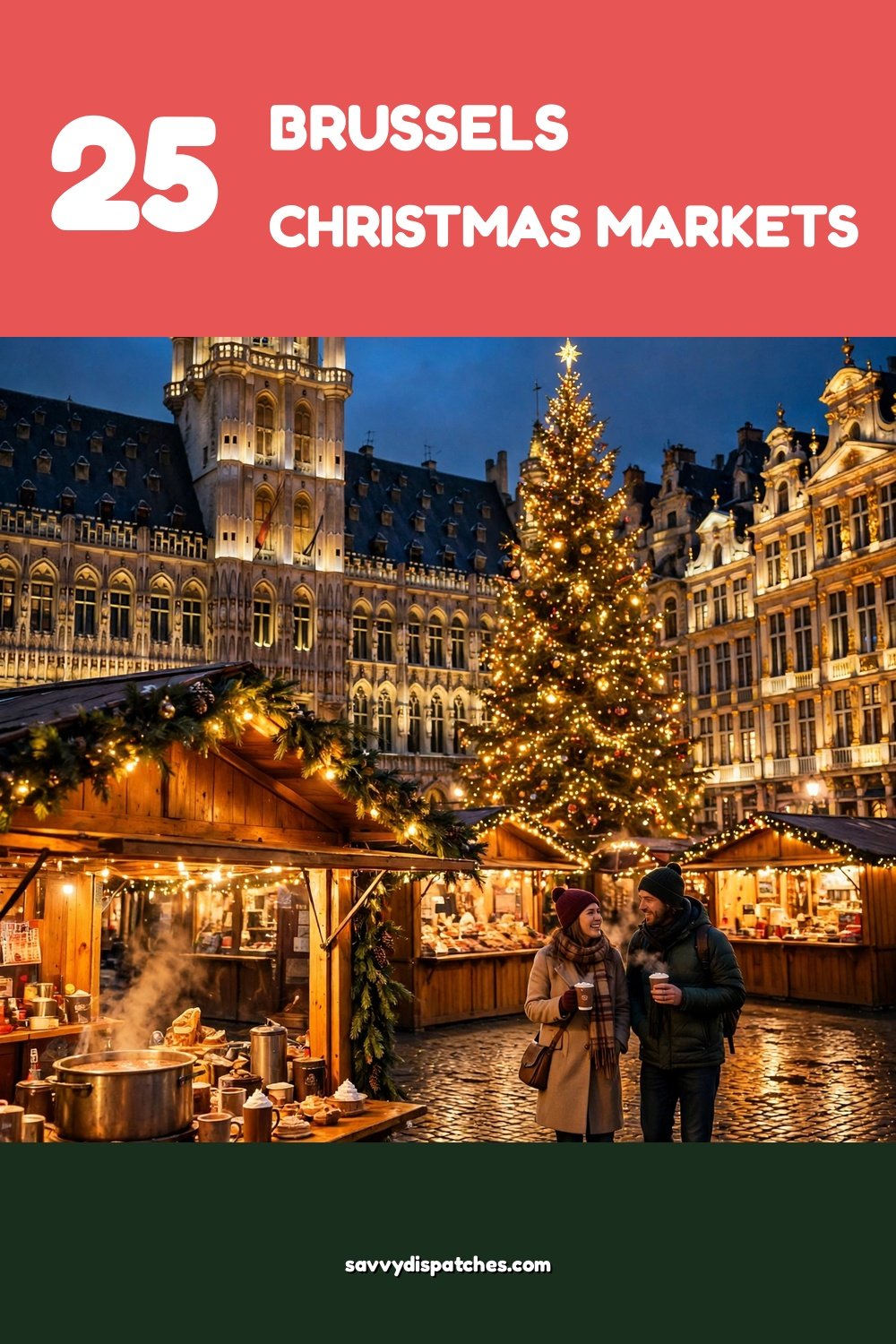
- Stop 1: The Grand-Place, the Tree and the Light Show
- Stop 2: The Bourse and the Basque and Béarn Village
- Stop 3: Sainte-Catherine, the Food Square of the Brussels Christmas Markets
- Stop 4: The Marché aux Poissons and the Ferris Wheel
- Stop 5: Place de Brouckère, the Ice Rink and the End of the Route
- The Full Walking Route: Grand-Place to the Fish Market in One Afternoon
- What to Eat and Drink at the Brussels Christmas Markets
- Brussels Christmas Markets on a Budget: What a Day Actually Costs
- Crowd Tips: How to Beat the Saturday Rush at the Brussels Christmas Markets
- Bruges Day Trip: The Christmas Market an Hour from Brussels
- Where to Stay and Getting Around Brussels in December
- You Might Also Like
Why the Brussels Christmas Markets Are Worth the Trip in 2026
Brussels does Christmas differently from Vienna and Budapest. There is no single square to tick off. Winter Wonders spreads over two kilometres through the lower town, from the Grand-Place to the old fish market, and you walk it like a trail, not a destination. The 2026 edition is the 25th, which means the city has had a quarter of a century to get the route right, and it shows: the chalets flow from square to square, the food gets better as you walk north, and the light show on the Grand-Place is the payoff at the end of the day.
The other reason is the price. Entry is free, the market opens at noon, and you pay only for what you eat, drink, and ride. A full afternoon of walking, eating, and watching the light show costs less than a single museum ticket in some cities. I went for two days, walked the route twice, and ate my way through it. For the budget method, my 11 best budget travel destinations for 2026 has the daily budget breakdown I use on every trip.
Local tip: Start at the Grand-Place at noon when the chalets open, not at dusk. You get the squares to yourself for two hours, and the light show is the evening reward, not the opening act.
Brussels Christmas Markets 2026: Dates, Hours and the Six Squares
Here are the dates to put in your calendar first. Winter Wonders 2026 runs Friday 27 November 2026 to Sunday 3 January 2027, daily 12:00 to 22:00, and it closes at 18:00 on 24 December, 31 December, and 3 January. Entry is free. The six squares are the Grand-Place, the Bourse, Place de la Monnaie, Sainte-Catherine, the Marché aux Poissons, and Place de Brouckère. The route runs about two kilometres from end to end, and it is flat all the way.
The best window is 1 to 20 December, when every square is open, the crowds are still manageable, and the light show runs every night. The last week before Christmas is the busiest, and the Saturdays in December are the days to avoid if you hate crowds. After Christmas the market stays open to 3 January, which makes it one of the few European markets still running in the new year.
Local tip: The market opens at noon, not in the morning, so plan a slow breakfast and a museum morning, then start the route at 12:00 sharp when the stalls are fresh.
Stop 1: The Grand-Place, the Tree and the Light Show
The Grand-Place is where the route starts and where it ends, and it is the square that justifies the trip. A tall Christmas tree stands in front of the Town Hall, a nativity scene sits in the square, and after dark the Town Hall facade and the guild houses become a screen for the sound-and-light show. The 2026 show is new, called Inspired by Brussels, and it runs every evening during Winter Wonders, except on 24 December, 31 December, and 3 January. Check the show times on the day, because the exact schedule was not published when I checked.
Stand in the middle of the square for the show, not at the edge, because the projections cover the whole facade and the sound carries best from the centre. The tree lights come on at dusk, and the square is at its best in the half hour after the first show, when the crowd thins and the gold of the guild houses glows against the dark. This is the one square to see twice: once in daylight, once at night. For the next city in the same style, my Paris in winter guide is the grander city to pair with Brussels.
Local tip: Watch the first light show from the middle of the square, then walk the route while the crowd stays behind for the second showing.
Stop 2: The Bourse and the Basque and Béarn Village
Walk north from the Grand-Place and you reach the Bourse, where the 2026 guest regions have their own village. Béarn Pyrénées and the Basque Country are the guests of honour this year, with a village on the square serving regional food, wine, and crafts. Look for Jurançon wine and Basque food, which you will not find at the other squares, and talk to the stallholders, because the guest village is the one place where the sellers are from somewhere else and happy to explain what they brought.
The Bourse itself is the grand building on the square, and the chalets here lean toward crafts and gifts rather than food. Buy here, eat later. The square is also the natural meeting point if your group splits up, because it sits in the middle of the route and every other square is a short walk away. For eating cheap between squares, my 10 grocery store meals for travelers looking to save money in Europe has the method I use for cheap eats on a city trip.
Local tip: Eat lunch at the guest village, not at the Grand-Place. The Basque and Béarn stalls serve food you cannot get anywhere else on the route, and the queues are shorter.
Stop 3: Sainte-Catherine, the Food Square of the Brussels Christmas Markets
Sainte-Catherine is where the chalets are thickest, wrapped around the church, and it is the square to come hungry to. The food stalls here cover the whole Belgian list: waffles, frites, croquettes, oysters from the old fish market trade, and mulled wine. A waffle costs around EUR 5, a cone of frites around EUR 4.50, and the prices are written on the boards, so read them before you order. The square also has a steampunk carousel for children, which costs around EUR 3 for ages 2 to 11, and lights projected onto the church from 17:00.
Eat standing up and keep moving, because the best food here is the food you eat with your hands while you walk. The seafood stalls near the old fish market are the local tradition, and the grey shrimp croquettes are the thing to try if you only try one. I ate two lunches on this square across two days and still did not cover all the stalls.
Local tip: Eat at Sainte-Catherine, not at the Grand-Place. The food choice is wider here, the prices are the same or lower, and you can eat while you walk to the next square.
Stop 4: The Marché aux Poissons and the Ferris Wheel
Keep walking north from Sainte-Catherine and you reach the Marché aux Poissons, the old fish market, where a double row of chalets runs down the long quays. This is the liveliest stretch of the route, with food on both sides and the 55-metre Ferris wheel rising over it all. The wheel cost EUR 10 for adults and EUR 6 for under-12s last year, so check the board on the day for this year’s price, and it turns from 12:00 to 22:00 through the whole festival. The cabins are closed, so it runs in any weather, and the view from the top covers the whole market below.
Ride the wheel at dusk, when the lights come on across the squares and the city glows below you. The queue is shortest in the early afternoon, and longest after dark, so ride early and watch the lights from the ground later. The beer pavilion beside the wheel serves the local brews, and it is a good warm stop if the wind picks up along the quays.
Local tip: Ride the Ferris wheel in the early afternoon, when the queue is short, then watch the lights from the ground at dusk. You get both views for one ticket.
Stop 5: Place de Brouckère, the Ice Rink and the End of the Route
Place de Brouckère is the northern end of the route, and it is where the skating happens. The ice rink sits under a transparent roof, so it runs whatever the weather, and skating costs EUR 12 from age 16, EUR 6 for younger skaters, and EUR 30 for a family of four, with skates included. There are curling lanes beside the rink, covered terraces for watching, and chalets around the square. The rink is not recommended for children under 6, and last entry is an hour before closing.
Skate on a weekday between 12:00 and 17:00, when the rink is quietest, and save the evening for the light show back at the Grand-Place. The square is also the easiest place to end the route, because the metro and the trams meet here and the walk back to the centre is flat and lit. If you only skate once, skate here, not at a pop-up rink elsewhere in the city. For the packing plan, my 35 carry-on packing tips has the cold-weather list I use.
Local tip: Skate on a Monday, Tuesday or Thursday between 12:00 and 17:00. Those are the quietest slots, and you will have room to actually skate instead of shuffling in a crowd.
The Full Walking Route: Grand-Place to the Fish Market in One Afternoon
Here is the route as I walked it, start to finish, in one afternoon. Start at the Grand-Place at 12:00, when the chalets open. Walk north to the Bourse for the guest village and lunch, then to Sainte-Catherine for the food square and the carousel. Continue to the Marché aux Poissons for the Ferris wheel, then finish at Place de Brouckère for the ice rink. The whole walk takes about two hours without stops, and four hours with food, rides, and photos, which is how you should do it.
Walk it south to north, not the other way. The food gets better as you go, the wheel sits at the far end as a reward, and the rink is the natural finish. Then take the metro back to the Grand-Place for the light show at dusk. The route is flat, the squares are lit, and the whole thing is free to walk, so the only cost is what you eat and ride.
Local tip: Walk the route south to north once in daylight, then take the metro back to the Grand-Place for the light show. The second viewing is free, and it is the best part of the day.
What to Eat and Drink at the Brussels Christmas Markets
Brussels is a food city, and the market proves it. Start with a waffle, either the Liège kind with caramelised sugar pearls or the Brussels kind, light and crisp, with chocolate or cream. A waffle costs around EUR 5. Then try the frites, which cost around EUR 4.50 with sauce, and the grey shrimp croquettes, which are the local speciality and worth the price. The mulled wine warms your hands, and the Belgian hot chocolate with a splash of amaretto is the drink to order at the bar beside the Ferris wheel.
For a real meal, sit down at a seafood restaurant near Sainte-Catherine, where the mussels are the tradition from the old fish market days. The market food is the fun, but the restaurants are the meal, and the prices are fair for the centre. Eat at the stalls for lunch and in a restaurant for dinner, and you will spend less than eating at the stalls three times a day. For the food plan at home, my 12 travel-inspired recipes to make at home when you miss Europe has the dishes I tried to copy when I got back.
Local tip: Read the price board before you order at every stall. Prices change between stalls, and the board is the only price that counts.
Brussels Christmas Markets on a Budget: What a Day Actually Costs
Brussels is fair value for a Christmas market city, because entry is free and the costs are all optional. Here is what a day costs per person, not counting the hotel. Food at the stalls: a waffle and frites for lunch, a croquette and a mulled wine in the afternoon, and a restaurant dinner near Sainte-Catherine. Rides: the Ferris wheel at EUR 10 last year, the carousel at around EUR 3 if you have children, and the ice rink at EUR 12. The light show is free, the walking route is free, and the squares are free to enter.
The cheapest day is the one where you walk the route, eat at the stalls, and watch the light show twice. The most expensive day is the one where you ride everything, eat at the stalls three times, and drink at every bar. I did the first kind on day one and the second kind on day two, and the first day was better. For the wider budget method, my 13 cheapest countries to visit in 2026 has the daily budget method I use for every trip.
Local tip: Set a ride budget before you start the route. The wheel and the rink are the two worth paying for, and the rest of the rides are easy to skip.
Crowd Tips: How to Beat the Saturday Rush at the Brussels Christmas Markets
The Brussels Christmas markets get crowded, and the crowds follow a pattern. Saturdays in December are the busiest days, the Grand-Place fills from 17:00, and the food squares jam up at dinner time. Weekday afternoons are calm, Sunday mornings are quiet, and the first week of December is calmer than the last week before Christmas. The market opens at noon, so the morning belongs to the museums and the cafés, and the route belongs to you from 12:00 to 15:00.
My rule was simple: walk the route in the afternoon, eat early, and watch the light show from the middle of the square before the second showing draws the biggest crowd. If you arrive on a Saturday, start at Place de Brouckère and walk south, against the flow, because most visitors start at the Grand-Place and the crowd moves north with them. For the wider Christmas plan, my 27 best Christmas destinations in the world puts Brussels next to the other cities on the same list.
Local tip: If you must visit on a Saturday, start at Place de Brouckère and walk south. You will walk against the crowd all afternoon instead of inside it.
Bruges Day Trip: The Christmas Market an Hour from Brussels
Bruges is the day trip that pairs with Brussels, and it is an easy one. Direct trains run from Brussels-Midi, Central, and Nord to Bruges in about an hour, every 30 minutes or so, and a standard single costs about EUR 17 to 23, with a weekend discount. No reservation is needed, and the ticket is valid on any train that day. Bruges Winter Glow runs 20 November 2026 to 3 January 2027, so it overlaps with Winter Wonders for the whole season.
Go early, because Bruges fills by midday. Walk the canals in the morning, climb the belfry if the queue is short, eat lunch by the Markt, and take an afternoon train back to Brussels for the light show. The two cities are different enough to justify the trip: Brussels is a big-city market trail, Bruges is a small medieval town dressed for Christmas. For the wider Europe plan, my 13 best Christmas markets in Europe for first-timers has the dates for the other cities. For the wider Europe plan, my 11 best Christmas towns in Europe worth the trip has the small-town version of this trip.
Local tip: Take the first train to Bruges and the afternoon train back. Bruges is best before midday, and the Brussels light show is the evening you do not want to miss.
Where to Stay and Getting Around Brussels in December
Stay near the Grand-Place or Brussels-Central, so you can walk to the start of the route and take the metro back at night. The lower town is flat, the squares sit close together, and the metro runs under the whole route. I stayed near Central and walked everywhere in the daytime, then took the metro from De Brouckère back to the Grand-Place for the light show. Book early, because the first weekend of Winter Wonders fills fast, and the hotels near the Grand-Place raise their prices in December. For the wider budget method, my 11 best budget travel destinations for 2026 has the daily budget breakdown I use on every trip.
Getting around is simple. The metro, trams, and buses all run on one ticket, and the route itself is a walk, not a ride. The airport train runs into Brussels-Central in about 20 minutes, and the train to Bruges leaves from the same station. For the packing plan, my 35 carry-on packing tips has the cold-weather list I use, and for the next city in the same style, my Copenhagen in winter guide is the colder, cosier version of the same trip.
Local tip: Stay within a ten-minute walk of the Grand-Place. It is the start and the end of the route, the light show is there, and every other square is a short walk north.
You Might Also Like
- Vienna in December: 30 Best Things to Do + Christmas Markets Guide (2026)
- Copenhagen in Winter: 12 Fun Things to Do (Hygge Guide 2026)
- Budapest Christmas Markets on a Budget + 3-Day Itinerary
Local tip: Read the Vienna guide next if you are adding a second city. It runs the same kind of walking route, and the two cities pair well on one trip.
