11 Free Things to Do in London Locals Actually Do (2026)
My first time in London I paid £32 to go up the Shard, £29 for the Tower of London, and £18 for the London Eye. All three were fine. None of them were the thing I remembered a year later.
- 1. Tate Modern {#tate-modern}
- 2. The British Museum {#british-museum}
- 3. National Gallery at Trafalgar Square {#national-gallery}
- 4. Natural History Museum {#natural-history-museum}
- 5. Sky Garden {#sky-garden}
- 6. Kyoto Garden in Holland Park {#kyoto-garden}
- 7. Columbia Road Flower Market {#columbia-road}
- 8. South Bank to Borough Market Walk {#south-bank-walk}
- 9. Changing the Guard at Horse Guards Parade {#horse-guards}
- 10. Hampstead Heath and the Ponds {#hampstead-heath}
- 11. Victoria and Albert Museum {#v-and-a}
- Quick Notes for First Timers {#quick-notes}
- You Might Also Like
What I remembered was the afternoon I got completely lost in Bermondsey, found a Turkish café where a full lunch cost £4.50, and spent three hours in the Tate Modern watching a room full of strangers stare at a Rothko like it owed them money. That visit cost me nothing. It was the best afternoon I have had in any city in Europe.
These are the 11 free things to do in London that locals actually do — the ones that do not show up on the tourist map but show up every week for people who actually live there. Every single one costs £0.
TABLE OF CONTENTS
- Tate Modern
- The British Museum
- National Gallery at Trafalgar Square
- Natural History Museum
- Sky Garden
- Kyoto Garden in Holland Park
- Columbia Road Flower Market
- South Bank to Borough Market Walk
- Changing the Guard at Horse Guards Parade
- Hampstead Heath and the Ponds
- Victoria and Albert Museum
1. Tate Modern {#tate-modern}
Tate Modern is one of the best art museums in the world. The permanent collection is free. The building — a converted Bankside power station on the south bank of the Thames — is worth the visit before you even get to the art inside.
The Turbine Hall alone (the vast entrance space) has hosted some of the most famous large-scale art installations of the past 25 years. Walk through it without reading any of the explanatory text, let your eyes adjust to the scale, and then go up to Level 2 and work your way through the modern and contemporary permanent galleries in whatever order you like.
The best rooms: the Surrealism galleries, the Rothko Room (Room 9, Level 4), and whatever the current Turbine Hall commission is. The paid special exhibitions are optional and often worth skipping unless the artist is someone you already care about.
Go on a Tuesday or Wednesday at 11am if you want the quietest experience. Go on a Sunday afternoon if you want the social version — the café on Level 6 has a Thames view and locals genuinely use it as a meeting point.
Local tip: The Tate Modern Members Room on Level 6 is private, but the public viewing terrace directly outside has the same view of the Thames, St. Paul’s, and the Millennium Bridge for free. It is better than the Shard view and costs nothing.
2. The British Museum {#british-museum}
The British Museum holds about 8 million objects from human history. The permanent collection is free and has been since 1753. This is one of the few places in the world where you can walk past the Rosetta Stone, look at the Elgin Marbles, and see an Egyptian mummy in an afternoon without paying anything.
The Great Court — the covered courtyard at the centre of the museum designed by Norman Foster — is one of the most beautiful interior spaces in London. It is also a good shortcut between the Russell Square tube exit and the museum’s back entrance.
Be strategic with your time. The Greek and Roman antiquities (Rooms 11–23), the Egyptian galleries (Rooms 61–66), and the Sutton Hoo helmet room (Room 41) are the three must-sees. A purposeful visit covering those takes 2 hours. Trying to see everything takes two days and leaves you flat on the floor.
Local tip: The Reading Room in the Great Court is open to the public during museum hours. Locals use it as a quiet study space. It is where Marx wrote Das Kapital, if you want the trivia. Worth walking through even if you just want somewhere cool to sit.
IMAGE PROMPT 1 — British Museum Great Court:
GENERATE (paste into Gemini/Flow — no text, no blank zones):
Full-bleed 1080x1920px portrait 9:16. The stunning glass-and-steel geometric roof of the British Museum Great Court in London — the white triangular lattice ceiling floods the circular courtyard with diffused daylight. A woman in a neutral trench coat walks across the cream stone floor looking upward at the roof structure. Reading Room entrance visible in soft focus behind her. Top 30% of frame shows the glass lattice roof in pale diffused light — naturally soft and bright without being a blank box, structural pattern creates visual interest. Subject in lower 60%. Sony A7IV 35mm, cool white diffused natural light, crisp clean aesthetic, film grain. Do NOT add text, boxes, or blank areas.
ADD OVERLAY IN IMAGE EDITOR AFTER GENERATING:
Category pill: “LONDON FREE” — coral #E85555 background, white Fredoka caps
Headline: “British Museum: Free Always” — More Sugar script, white, cream backing
Accent line: “11 free London experiences inside” — Fredoka Bold, coral, white box
Bottom: “savvydispatches.com” — small centered white text
IMAGE DESCRIPTION 1: The geometric glass lattice of the British Museum’s Great Court roof — designed by Norman Foster — floods the circular courtyard with soft diffused daylight. A traveler in a trench coat crosses the cream stone floor looking upward at the structure above. This is one of the most beautiful interior spaces in London, and it has been free to enter since 1753.
3. National Gallery at Trafalgar Square {#national-gallery}
The National Gallery has 2,300 paintings spanning 700 years of Western European art. The permanent collection is free. It faces Trafalgar Square, which means you can combine a visit with the square’s fountains, the lions at Nelson’s Column, and St. James’s Park directly behind Downing Street — all free.
The collection is arranged chronologically and geographically. If you have limited time: Van Eyck’s Arnolfini Portrait (Room 56), Velázquez’s Rokeby Venus (Room 30), Rembrandt self-portraits (Room 24), and the Impressionist rooms 43–46 (Monet, Renoir, Seurat, Cézanne). Room 34 alone — Caravaggio, Rembrandt, Vermeer — justifies the visit.
The National Gallery Café is slightly overpriced. The Pret A Manger on the Strand is a two-minute walk and significantly cheaper. Pack snacks, eat in Trafalgar Square, come back in.
Local tip: The gallery stays open until 9pm on Fridays. Locals who work nearby come after work, when the school groups and tourist tour buses are long gone. Friday after 6pm is the best time to see the gallery without crowds.
4. Natural History Museum {#natural-history-museum}
The Natural History Museum in South Kensington is one of London’s most beautiful buildings. The Romanesque terracotta façade on Cromwell Road is legitimately one of the finest pieces of Victorian architecture in the UK. And it is free.
Inside: the blue whale skeleton in Hintze Hall (hanging from the ceiling since 2017), the dinosaur gallery (Level 1, the T-Rex model still draws a crowd every day), the Vault downstairs with meteorites and gemstones, and the Earth Galleries through the green zone. The Darwin Centre has a behind-the-scenes science wing with a 17-metre glass Cocoon structure that is worth 30 minutes.
Combine this with the Victoria and Albert Museum (entry 15 on this list) and the Science Museum next door — all on Exhibition Road, all free — for a full South Kensington day that costs nothing except food.
Local tip: The Natural History Museum Wildlife Photographer of the Year exhibition runs October through June each year. Entry to the exhibition is paid (£15–17), but the permanent collection and the building are free year-round.
5. Sky Garden {#sky-garden}
The Sky Garden at 20 Fenchurch Street (“the Walkie-Talkie building”) is a free public garden at the top of a skyscraper in the City of London. Floor-to-ceiling glass, tropical and Mediterranean plants, and 360° views across London including St. Paul’s, the Shard, the Tower of London, and on clear days the North Downs in Surrey.
The catch: you must book in advance online at skygarden.london. It is free. But it fills up fast, especially weekends. Book at least 2–3 days ahead. The best time slots are 9am–10am on weekdays (fewest people, sharpest light for photos) and 6–8pm on any day for the sunset view across the city.
The bar and restaurant inside are expensive. Order a coffee or a soft drink if you want a seat with a view. Walking through without buying anything is totally fine — there is no minimum spend policy.
Local tip: The eastern terrace (not the main internal garden area) has a bench that faces directly toward the Thames and Tower Bridge. It is the least crowded corner and has the best composition for photos. Turn right after exiting the lifts.
IMAGE PROMPT 2 — Sky Garden London:
GENERATE (paste into Gemini/Flow — no text, no blank zones):
Full-bleed 1080x1920px portrait 9:16. Inside the Sky Garden at 20 Fenchurch Street, London — lush tropical plants and Mediterranean shrubs fill the foreground while floor-to-ceiling curved glass windows reveal a panoramic view of London rooftops, the Thames, and St. Paul’s Cathedral dome in soft golden afternoon light beyond. A woman in a light tan blazer stands beside a large fern looking out at the city view. Top 30% of frame shows the angled glass ceiling and London skyline beyond — pale blue afternoon sky through glass creates a naturally bright, airy top zone, no blank box. Subject in lower 55%. Sony A7IV 35mm, warm afternoon light, vibrant greens and warm city tones, film grain. Do NOT add text, boxes, or blank areas.
ADD OVERLAY IN IMAGE EDITOR AFTER GENERATING:
Category pill: “LONDON FREE” — coral #E85555 background, white Fredoka caps
Headline: “Sky Garden: Free, Book Ahead” — More Sugar script, white, cream backing
Accent line: “Best free view in London” — Fredoka Bold, coral, white box
Bottom: “savvydispatches.com” — small centered white text
IMAGE DESCRIPTION 2: Lush tropical plants fill the Sky Garden at 20 Fenchurch Street as a traveler in a tan blazer looks out at the panoramic London skyline beyond the floor-to-ceiling glass. St. Paul’s dome floats in afternoon haze behind her. Entry to this rooftop garden is completely free — you just need to book ahead online. It is the best free view in London and most tourists have never heard of it.
6. Kyoto Garden in Holland Park {#kyoto-garden}
Holland Park is in Kensington, west London, and it takes about 25 minutes by tube from central London. Most tourists never make it this far. Inside Holland Park, behind the peacocks that roam freely on the lawns, there is a formal Japanese garden called the Kyoto Garden. It was gifted to London by the city of Kyoto in 1991.
It is genuinely beautiful. A tiered waterfall feeds a koi pond, Japanese maples frame the paths, and stone lanterns sit at the water’s edge. In autumn (October–November) when the maples turn, it is one of the most photographed spots in London. You are not fighting crowds to see it because most people do not know it exists.
Holland Park also has a wildlife reserve, the ruins of Holland House (bombed in WWII), formal Dutch gardens, and an open-air opera theatre (paid, summer). The whole park is free, open dawn to dusk, and takes about 90 minutes to walk properly.
Local tip: The peacocks in Holland Park are fully wild and breed in the park. In spring, the male peacocks display their tail feathers — a genuinely absurd spectacle in the middle of a London public park. Best sightings: early morning near the Orangery café.
7. Columbia Road Flower Market {#columbia-road}
Columbia Road Flower Market runs every Sunday from 8am to 3pm in Bethnal Green, east London. It is one street lined with stalls selling cut flowers, potted plants, bulbs, herbs, and seasonal displays at wholesale prices. Locals buy their flowers here every week. The atmosphere — street traders shouting their prices, the smell of eucalyptus and roses, the independent coffee shops spilling out onto the pavement — is one of the most London things you can experience.
You do not have to buy anything. Walk it once end to end (about 300 metres), double back, stop at one of the small independent coffee shops on the side streets (Laxeiro, Lily Vanilli for a cake), and leave. The whole experience takes about an hour and costs whatever you choose to spend.
Go between 9am and 11am. After midday, it gets crowded enough that you will be walking sideways through it and the best flowers are already gone.
Local tip: The small shops that line Columbia Road between the flower stalls sell ceramics, vintage homewares, and local art. Several open only on Sundays. They are well worth browsing and none of them have an entrance fee.
8. South Bank to Borough Market Walk {#south-bank-walk}
The walk from Tate Modern along the Thames South Bank to Borough Market covers about 1.2 kilometres and takes 15–20 minutes at a stroll. It is the best free walk in London.
Along the way: the Millennium Bridge crossing (free), Southwark Cathedral (free to enter), the Shakespeare’s Globe exterior and small free exhibition, street food stalls under Waterloo Bridge on weekends, skateboard park under the Hungerford Bridge, the Book Market under Hungerford Bridge (Friday, Saturday, Sunday — secondhand books, prints, maps).
Borough Market is free to walk through, with free samples at many stalls on a good day. Eating there is expensive (£8–12 for street food items). Buying ingredients is mid-range. The architecture — Victorian cast-iron market roof, adjacent Southwark Cathedral, cobblestones — is worth the trip even if you only buy a coffee.
Local tip: The least expensive and most local thing you can eat at Borough Market is a Raclette Bros cheese-over-potato for about £7 — better than most restaurant meals nearby at £15–20, and you eat standing at a counter watching the market flow around you.
9. Changing the Guard at Horse Guards Parade {#horse-guards}
Everyone knows the Changing of the Guard happens at Buckingham Palace. What fewer people know is that the Mounted Guard Change happens daily at Horse Guards Parade in Whitehall — it is smaller, closer, less crowded, and frankly more interesting.
The Household Cavalry change happens at 11am Monday to Saturday and 10am Sunday. You can stand within 3 metres of the mounted Life Guards. No crush barriers, no queue, no ticket. It lasts about 30 minutes.
The building behind Horse Guards Parade opens its ground floor as a small Household Cavalry Museum (entry £9 for the museum, free to watch the parade). The parade itself is visible from the street — you do not need to enter the building for the main event.
Local tip: After the guard change, walk directly through Horse Guards Parade toward St. James’s Park. The view of the lake from the blue bridge in St. James’s Park — with Buckingham Palace behind you and Horse Guards Parade in front — is one of the most reliably beautiful urban views in London.
IMAGE PROMPT 3 — Borough Market and South Bank:
GENERATE (paste into Gemini/Flow — no text, no blank zones):
Full-bleed 1080x1920px portrait 9:16. Under the Victorian cast-iron roof of Borough Market in London — warm afternoon light filters through old glass panes above, illuminating stone walls and market stalls selling artisan cheeses, bread, and fruit below. A woman in a rust-orange coat browses a cheese stall, talking to the stallholder. Market crowds visible in warm soft-focus behind her. Top 30% of frame shows the Victorian iron-and-glass roof structure with warm diffused natural light from above — not a blank box but beautifully textured old market architecture. Subject in lower 60%. Sony A7IV 35mm, warm afternoon market light, rich amber and earth tones, film grain. Do NOT add text, boxes, or blank areas.
ADD OVERLAY IN IMAGE EDITOR AFTER GENERATING:
Category pill: “LONDON FREE” — coral #E85555 background, white Fredoka caps
Headline: “Borough Market: Walk In Free” — More Sugar script, white, cream backing
Accent line: “South Bank free walking guide” — Fredoka Bold, coral, white box
Bottom: “savvydispatches.com” — small centered white text
IMAGE DESCRIPTION 3: Warm afternoon light filters through the Victorian iron-and-glass roof of Borough Market as a traveler in a rust coat browses an artisan cheese stall. Walking Borough Market is entirely free — and on a good day the samples alone are a meal. Combine it with the Millennium Bridge, Tate Modern, and the South Bank walk for a full London afternoon that costs nothing.
10. Hampstead Heath and the Ponds {#hampstead-heath}
Hampstead Heath is 790 acres of ancient parkland in north London. It is where Londoners go when they need to stop feeling like they live in a city. The views from Parliament Hill look south across the entire London skyline. On a clear day you can see the Shard, the Gherkin, and the dome of St. Paul’s all at once.
The Heath has three bathing ponds — men’s, women’s, and mixed — that are open for wild swimming year-round. Entry to the ponds costs £2 for adults. The water is cold, murky, natural, and absolutely refreshing. Londoners swim here all year including winter. The women’s pond in particular has a dedicated community that swims every morning regardless of temperature.
The rest of the Heath is entirely free: the main path from Highgate village through the woods to Kenwood House (free, has a café), across the meadows to Parliament Hill, and down toward Gospel Oak and Hampstead tube stations. Allow 2–3 hours for the full walk.
Local tip: Kenwood House at the northern edge of Hampstead Heath is a free English Heritage property with a Rembrandt self-portrait and a Vermeer in its permanent collection. Most people walk straight past it. It is one of the quietest great art collections in London.
11. Victoria and Albert Museum {#v-and-a}
The Victoria and Albert Museum in South Kensington is the world’s largest museum of art and design. Permanent collection: free. It covers fashion, furniture, ceramics, jewellery, architecture, photography, and theatre design across 145 galleries.
The Fashion Galleries (Room 40) have dresses from 1600 to now. The Cast Courts (Rooms 46a and 46b) have full-scale plaster casts of Trajan’s Column and Michelangelo’s David — made in the 19th century when originals were inaccessible and now themselves historically significant objects. The Jewellery Gallery (Room 91–93) includes the world’s largest collection of European jewellery from 3,000 BC to now.
The V&A café in the original Victorian refreshment rooms is genuinely worth a look — three tiled and painted dining rooms from the 1860s that are some of the oldest museum restaurant interiors in the world. A coffee there costs £4.50, which is expensive, and it is worth paying once.
Local tip: The V&A has a programme of free Friday Late events once a month — the museum stays open until 10pm, there is live music in the café, bar set up in the fashion galleries, and none of the Saturday school-holiday crowd. Check the V&A website events calendar before you visit.
Quick Notes for First Timers {#quick-notes}
The tube is the fastest way between most of these spots but it adds up. A single zone 1–2 tube journey costs £2.80 with a contactless card or Oyster. Get a contactless bank card working before you land (or pick up an Oyster card at any tube station) — the daily cap is £8.10 for zones 1–2, which means unlimited travel once you hit it.
The best days for free London: weekday mornings at museums (emptiest), Sunday mornings at Columbia Road (freshest market), Friday evenings at the National Gallery and V&A (open late, quietest).
Paid attractions worth their price if you have the budget: the Tower of London (£34.80, do the Crown Jewels before 11am), Shakespeare’s Globe tour (£17), the Churchill War Rooms (£30). Everything else on this list costs £0.
You Might Also Like
- 11 Affordable European Destinations for Solo Female Travelers — cities where the whole trip costs less than London for a week
- 9 Europe Trip Planning Mistakes That Waste Money — what to avoid before you book
- 10 Grocery Store Meals for Travelers in Europe — eating cheap in any European city
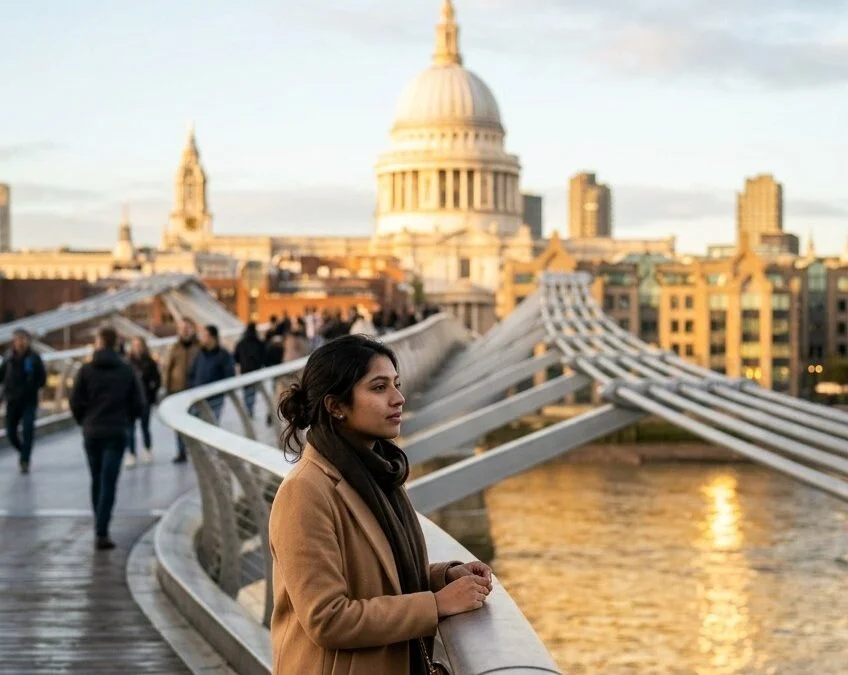
1280x720px landscape, no text — the Millennium Bridge in London with St. Paul’s Cathedral in the background, taken from the south bank, blue sky, warm afternoon light, people crossing the bridge. Blog display only.