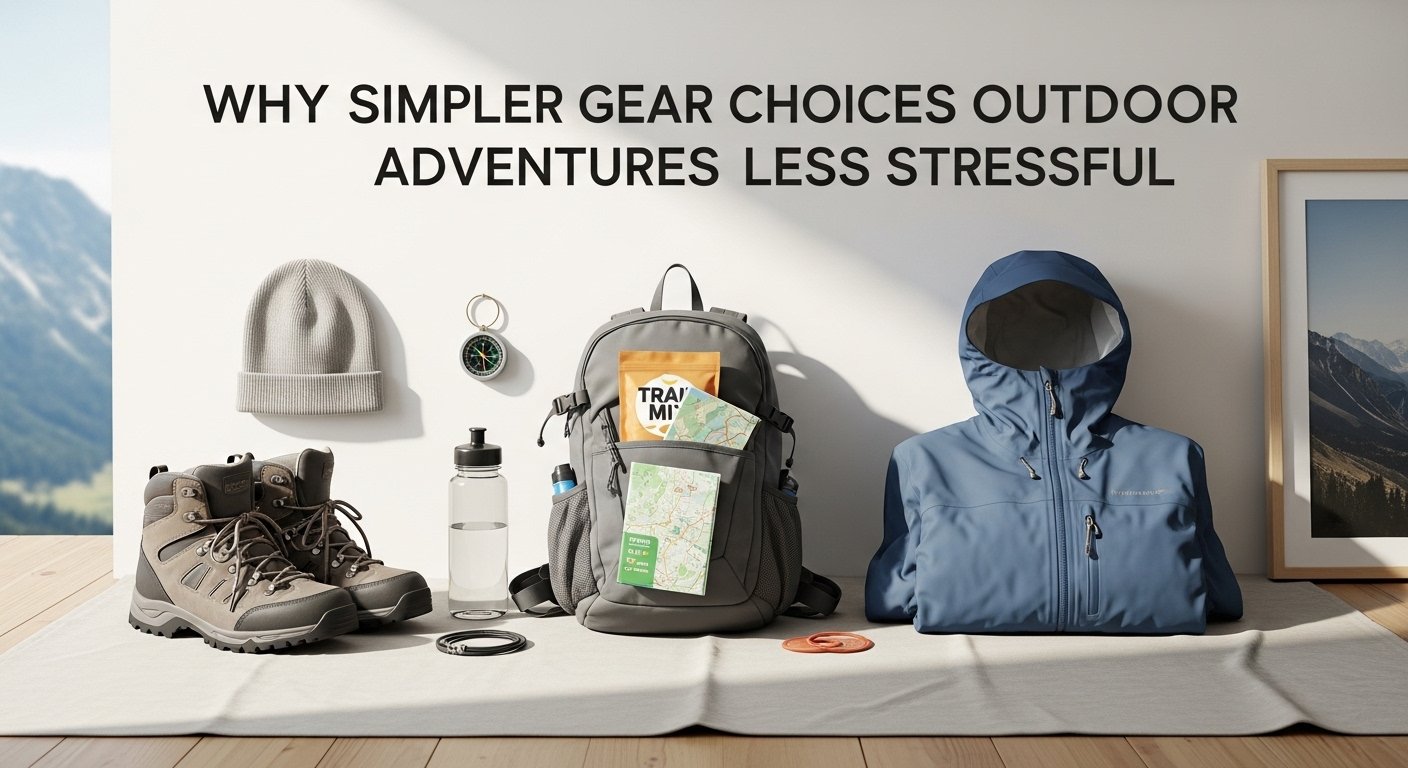
I used to think being “prepared” meant bringing everything.
- The Hidden Stress of “Over-Optimizing” the Outdoors
- When Gear Starts Dictating the Experience
- The Moment I Realized “Simple” Is a Feature
- Simplicity Isn’t About Doing Less — It’s About Removing Friction
- Why Fewer Decisions Lead to Better Adventures
- The Confidence Factor (Underrated but Huge)
- Why Experienced Adventurers Downsize Their Systems
- Stress Shows Up in Small Ways
- The Goal Was Never the Gear
- A Better Question to Ask Before Buying Anything
- Final Thought: Less Gear, More Headspace
Extra straps. Backup tools. Multiple bags for the same activity. A whole mental checklist that started days before the trip and somehow followed me onto the road. And honestly? It was exhausting.
Somewhere along the way, outdoor adventures started to feel more like logistics exercises than escapes. I wasn’t relaxing — I was managing gear. Constantly double-checking whether things were secure, packed right, or going to rattle loose after the first pothole.
If you’ve ever stood in your driveway wondering why a weekend outside suddenly feels harder than a normal workday, you’re not alone.
The truth is that more gear doesn’t equal less stress. In fact, it often does the opposite.
The Hidden Stress of “Over-Optimizing” the Outdoors
There’s a weird pressure in outdoor culture that says more is better. More equipment. More features. More accessories. More backups for your backups.
It sounds smart in theory. But in practice? It creates friction.
Every extra piece of gear adds:
- Another decision to make
- Another thing to secure, store, or worry about
- Another potential failure point
I’ve watched people spend half an hour loading bikes, adjusting straps, re-tightening mounts, and second-guessing everything — before they’ve even left the driveway. By the time they hit the trailhead, they’re already mentally drained.
That’s not what getting outside is supposed to feel like.
According to a study summarized by the American Psychological Association, decision fatigue is real — the more small choices we make, the more stressed and mentally taxed we become over time. And outdoor prep is full of small choices.
When Gear Starts Dictating the Experience
I’ve seen this play out over and over.
Someone buys a system that technically works… but only if everything is loaded in the perfect order, tightened just right, and checked again mid-drive. Suddenly the whole trip revolves around the gear instead of the adventure.
You stop spontaneously grabbing lunch on the way because you don’t want to leave the car unattended. You skip side trips because unloading and reloading feels like too much work. You rush home instead of lingering because you’re already thinking about taking everything apart again.
At that point, the gear is running the show.
And that’s when people start quietly looking for simpler solutions — not because they want less capability, but because they want fewer mental hoops.
The Moment I Realized “Simple” Is a Feature
I remember one trip where everything clicked.
We packed faster. We loaded bikes in minutes instead of wrestling with straps. No awkward lifting. No re-adjustments. No constant glances in the rearview mirror wondering if something was shifting back there.
It was the first time in a long while that the prep felt calm.
A friend had recently switched to a vertical hitch setup from VelociRAX, and watching how effortless the process was changed my perspective completely. The bikes went on. They stayed put. And that was it. No drama. No tinkering.
That one change eliminated about ten micro-stressors I didn’t even realize I was carrying.
And it got me thinking: why do we tolerate complicated gear when the goal is freedom?
Simplicity Isn’t About Doing Less — It’s About Removing Friction
There’s a difference between being underprepared and being overcomplicated.
Good gear should:
- Reduce steps, not add them
- Fade into the background once it’s in use
- Let you focus on the experience, not the setup
REI has a great breakdown on how thoughtful gear choices improve outdoor enjoyment, especially when it comes to ease of use and reliability. They emphasize that gear should support the activity, not become the activity itself.
That’s the shift more experienced outdoor folks tend to make over time. Beginners often chase features. Veterans chase simplicity.
Why Fewer Decisions Lead to Better Adventures
Let’s be real — most of us are already decision-fatigued before the weekend even starts.
Work. Family logistics. Schedules. Notifications. Deadlines.
When your outdoor setup requires another layer of thinking, it defeats the point. The best trips I’ve taken recently all had one thing in common: minimal decision-making once the car was packed.
The National Park Service encourages visitors to streamline prep so they can stay present and adaptable during trips, especially when plans change due to weather or conditions.
Less complexity gives you flexibility. And flexibility is what turns a good plan into a great memory.
The Confidence Factor (Underrated but Huge)
There’s also something to be said for confidence.
When you trust your setup, you relax. You stop checking mirrors. You stop pulling over “just to be safe.” You stop worrying about whether something’s rubbing, shifting, or slowly coming loose.
That confidence carries into the rest of the trip. You drive easier. You arrive in a better mood. You’re more patient with delays and detours.
It’s subtle, but it matters.
Why Experienced Adventurers Downsize Their Systems
Talk to people who’ve been doing this for years — mountain bikers, skiers, overlanders, climbers — and you’ll notice a pattern.
Their setups get cleaner over time, not more complex.
They’ve already learned:
- What they actually use
- What never leaves the bag
- What causes the most frustration
And they slowly eliminate the rest.
Outside Magazine has written about this exact progression — how seasoned outdoor enthusiasts gravitate toward fewer, better-designed pieces of gear instead of sprawling setups.
It’s not about minimalism for the sake of it. It’s about removing obstacles between you and the experience.
Stress Shows Up in Small Ways
Stress isn’t always loud.
Sometimes it looks like:
- Snapping at your travel partner over nothing
- Feeling rushed even when you’re not on a schedule
- That low-grade irritation you can’t quite name
And a surprising amount of that comes from preventable friction.
When loading is easy, storage is intuitive, and transport feels secure, your nervous system settles down. You don’t feel like you’re managing a problem — you feel like you’re going somewhere.
The Goal Was Never the Gear
This is the part people forget.
No one gets into outdoor adventures because they love equipment. They get into it because they love how it feels to be outside. The quiet. The movement. The reset.
Gear is just a means to an end.
When it becomes the source of stress, it’s worth rethinking the setup — even if it technically works.
A Better Question to Ask Before Buying Anything
Instead of asking:
- “How many features does this have?”
Try asking:
- “How much thinking will this require every time I use it?”
That one question filters out a lot of unnecessary complexity.
The best gear choices I’ve made lately are the ones I barely think about anymore. They just do their job and get out of the way.
Final Thought: Less Gear, More Headspace
Outdoor adventures don’t need to be optimized to death.
They need room to breathe.
When you simplify your gear choices, you’re not cutting corners — you’re creating space. Space for spontaneity. Space for enjoyment. Space to actually unplug.
And once you experience a trip where everything just flows, it’s hard to go back.
Honestly, that’s when the outdoors start feeling like an escape again — not another system to manage.