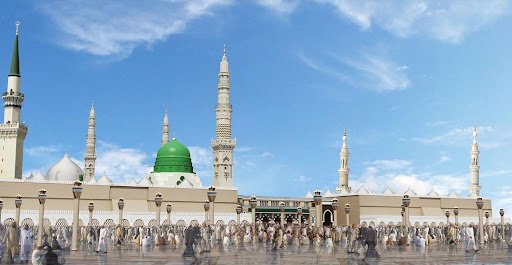
Masjid e Nabwi, the Prophet’s mosque, holds a special place in the heart of every Muslim. With a total capacity of 1.5 million people, it is not only the second largest mosque in the world but also has the honor of being built by the hands of Prophet Muhammad (PBUH) and his companions. Located in the beautiful and holy city of Medina, it was built after the migration of Muslims from Makkah. The mosque’s green tomb, big umbrellas and stunning architecture are its identity.
Today millions of Muslims from all over the world visit this place during their Umrah and Hajj trips. Visiting this mosque and praying here is nothing short of a dream come true for Muslims. For Muslims coming to the city for business or religious purposes, praying here is an essential part. Many pilgrims from all over the world look for Umrah Packages that offer extended stays in the city. The mosque you see today is a result of various renovations during different times. Originally, it was a simple but multifunctional structure at the time of the Holy Prophet Muhammad (PBUH).
The Role of Masjid e Nabwi During the Prophet’s (PBUH) Time
If you have booked an Umrah package and plan to travel to the holy cities of Makkah and Medina, this post can help you understand the real purpose of Masjid e Nabwi. Let’s explore the different ways in which this mosque served the early Muslims of Islam.
A Place of Worship
The basic purpose of building Masjid e Nabwi was to provide a safe and secure place for early Muslims to pray. Prophet Muhammad (PBUH) and his companions had nothing to live by when they came to Medina. The Holy Prophet (PBUH) realised the need for having a dedicated praying place for Muslims. The Prophet (PBUH) led the five daily prayers and Jumma prayers here. During the month of Ramadan, the special prayer, Taraweeh, also took place here. Many Surahs in the Holy Quran were revealed to the Prophet (PBUH) at this sacred mosque. The companions of the Prophet (PBUH) recited and memorised prayers here, and he also held explanatory sessions here. The mosque serves as a place for connection with Allah. Muslims used to sit in the mosque long after prayers and do Dhikr (remembrance) of Allah here.
A Centre of Learning and Education
Apart from serving as a place to offer prayers, Masjid e Nabwi was a learning hub for Muslims. The Holy Prophet (PBUH) directed the companions to build a dedicated shaded area where people can sit and learn Allah’s commands. This area was known as Suffah, and the people who used to sit there came to be known as Ahl e Suffah. These companions were taught directly by the Prophet (PBUH) himself. The leading names among Ahl e Suffah were Abu Huraira, Abuzar Ghifari, and Bilal bin Rabah.
During Suffah sessions, the Holy Prophet (PBUH) delivered Quranic lessons, shared Hadiths, taught life skills and also trained future leaders. The best part about Suffah was that there were no restrictions; anyone could come and join the sessions. Even ladies, kids and elderlies were also welcome. The Suffah section can be found in the northern part of the Masjid e Nabwi. Families that want to show and teach their children about such historic sites can book Family Umrah Packages to travel to Makkah and Medina.
Administration Headquarters
The mosque served many purposes for Muslims. One of these was being the administrative headquarters of the recently found Muslim community. The Holy Prophet (PBUH) used the place to hold key meetings with his companions about foreign policy, community welfare, and relations with infidels and Jews living in Medina. The judicial decisions were also taken inside the mosque.
He also held Shura (consultative meetings) with his senior companions and showed them the importance of taking mutual decisions. In the present world, the mosque doesn’t play any such role, but its importance as the hub of Muslims can never be forgotten. If you also want to explore the places where the Holy Prophet (PBUH) once sat and made important decisions, book all inclusive Umrah packages and travel to the city of Medina without worrying about logistics.
Strategic and Military Planning
The Holy Prophet (PBUH) fought many battles during his life, and most of them were fought from the city of Medina. The nascent Muslim community was attacked several times by the infidels, and at such times the mosque served as a centre for planning military expeditions and mobilising resources. The major battles for which Masjid e Nabwi served as a base were Badr and Uhud. Once the battle was over, Muslims held a meeting in the mosque to divide the loot, discuss their faults and tend to the wounded. While the mosque was a sanctuary of peace for everyone who wanted shelter, it also served as a training ground for Muslims for battle. The trained warriors taught other companions and prepared them for tough times.
A Social and Community Centre
The Holy Prophet (PBUH) didn’t stop anyone from entering the mosque, as he wanted to show the true spirit of Islam. The homeless, poor, travellers, and even non-Muslims who came to learn about Islam all received excellent treatment at the hands of the Holy Prophet (PBUH). The mosque provided them a place to rest, gave them food, and even helped with some extra cash. This is the reason that many people accepted Islam and became Muslims. The Holy Prophet (PBUH) officiated marriages and listened to disputes among believers in the mosque.
Moral and Ethical Foundation for Society
Islam is all about morals and ethics. One of the earliest purposes of building Masjid e Nabwi was to nurture a moral and ethical society. While in Makkah, he and his companions were unable to practise Islam in its true spirit, as infidels would chase after them. The principles like justice, compassion, brotherhood, and humility were not just preached but practised inside the mosque. Gradually, these principles spread all over the city, and Medina started to get famous as one of the best cities of the time. It was in the mosque that Holy Prophet Muhammad (PBUH) practically showed that Islam treats everyone equally. No matter the race, class, background, financial status, or gender, all are equal in Islam.
Final Words
During the times of Prophet Muhammad (PBUH), Masjid e Nabwi was the heart of a Muslim community and served as a base to spread Islam across the world. Even after the Prophet (PBUH), the caliphs used the mosque and city of Medina as their headquarters. Every UK Muslim wishes to see the beautiful Prophet’s mosque at least once in their life. One easy way to do this is to book Umrah packages UK, do pilgrimage and then pray at Masjid e Nabwi. For all such people, Muslims Holy Travel is right here to help them. They are one of the best Umrah tour operators in the country and offer all inclusive Umrah packages at affordable prices.