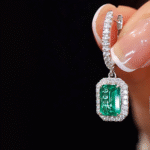

You’ve likely admired the vivid green of gemstones. You may ask: What causes the green color in gemstones? Understanding the science behind it will enhance your enjoyment when wearing your green gem jewelry.
Well, green gems get their color from trace elements like chromium and vanadium, iron, structure, and light absorption, mineral inclusions like chlorite or actinolite.
Here, we will discuss the science behind the coloration of green gems. You’ll learn that chemistry, crystal structure, color, and light all play key roles.
The Basic Science Behind the Gemstone Color
The causes of gemstone color are always fascinating. Color depends on the gem’s structure and chemistry.
Gem color origins start with the crystal lattice and how light interacts with it. Tiny impurities, known as trace elements in gems, often make all the difference and create new colors.
Elemental impurities in crystals absorb certain wavelengths. That selective absorption gives gems their unique hues.
Trace Elements: The Hidden Artists of Color
Green gemstone chemistry relies on trace impurities. These often exist in parts per million.
They subtly change light absorption. Accordingly, gemstone color variations can occur from the same element. A single impurity can yield different colors. Conversely, different elements can yield similar colors.
This principle also applies to natural vs synthetic coloration. Lab-grown gemstones don’t just imitate color on the surface. They develop with the same crystal structure as natural stones, and the same trace elements in gems—like chromium or iron—create their hues.
That’s why a lab emerald can look just as green as one from a mine. To most eyes, the two appear identical. The difference usually only shows up under advanced testing, where experts can spot growth patterns or inclusions that nature and a lab form differently..
What Causes Green Color in Gemstones
Now let’s get to the point– what causes the green color in gems? Here are the things behind it.
1. Chromium and Vanadium: The Emerald’s Signature Green
You’ll find that chromium and vanadium in emeralds give emeralds their classic green. These elements substitute for aluminum in the beryl crystal lattice, altering how light is absorbed so that green wavelengths pass through
In light absorption in gemstones, these effects depend on both the trace elements in gems and the gem’s lattice. That interplay is key to the science of gemstone hues.
More chromium yields a deeper color. A mix of both chromium and vanadium can range from yellow-green to bluish-green. Natural mineral inclusions and color interact, sometimes dulling or enhancing the green. Those are called “jardin” (These inclusions can look like moss, roots, or little plant-like patterns, which is why they earned the name. They’re usually made up of tiny crystals, fractures, or fluids trapped while the emerald formed.) in emeralds.
2. Iron in Green Tourmaline and Jade (and Beyond)
In green tourmaline, the type of iron matters a lot. Ferrous iron (Fe²⁺) creates the rich green tones people love. Ferric iron (Fe³⁺), on the other hand, can push the color toward yellow or brown.
Sometimes, green also comes from the way ferrous iron (Fe²⁺) interacts with titanium (Ti⁴⁺) through a process called charge transfer. In other gems, like sapphire, green can instead come from chromium (Cr³⁺) or vanadium (V³⁺) alone.
In jadeite, pure sodium aluminum silicate would be colorless. What gives it green is when tiny amounts of other elements sneak into the crystal.
If iron (Fe³⁺) takes aluminum’s place, you get a softer, light green. When chromium (Cr³⁺) does it, you see that rich, emerald green. These swaps change how the stone absorbs light, letting green around 520 nm shine back at you.
3. Other Causes of Green in Gems
Not all green comes from chromium, vanadium, or iron. Mineral inclusions and color—like chlorite or actinolite—can impart green tones.
Some gems gain color from radiation or structural defects. Peridot green comes from iron, while demantoid garnet owes its hue to chromium.
Even the famed alexandrite changes from green in daylight to red under incandescent light. That shift arises from chromium-induced absorption differences and light source effects.
How to Determine the Natural or Dyed Color with Advanced Tools: Spectroscopy in Gemology
Sometimes jade, emerald, or other green gems are dyed to fake the effect. Advanced tools, such as spectroscopy, can reveal whether a stone’s green color is natural or artificially added.
Spectral analysis reveals which trace elements are present. It also differentiates natural from synthetic color sources.
For tourmaline; copper, and iron produce different absorption patterns. Copper shows strong bands near 900 – 925 nm, not seen in iron. These tools help trace the science of gemstone hues.
Final Thoughts
What causes green color in gemstones is a smart mix of green gemstone chemistry, trace elements in gems, and how light interacts with the crystal structure.
Whether chromium, vanadium, iron, or inclusions cause it, understanding this helps you pick gems wisely. It also adds a layer of appreciation for natural beauty and natural vs synthetic coloration.
We would like to remind you that at Saratti, every green gemstone — whether natural or treated — comes with transparent certification, so you know exactly what you’re getting. With their fair return and warranty policy, you can choose with confidence.