Every production undertaking, whether or not it’s a modest home addition or a large industrial construct, starts with one vital query: How much will it cost? That question isn’t just about dollars—it sets the stage for scheduling, design selections, labor management, or even the final fine of the shape. Cost estimation, whilst executed cautiously, turns into the backbone of a successful challenge. Without it, even the first-class designs and the most skilled teams can stumble.
Why Estimation Matters
Imagine beginning a build without understanding how much fabric you’ll need or whether the price range can cover the hard work for the entire length. Projects that pass or underestimate costs frequently face delays, unfinished systems, or strained relationships among customers and builders. A realistic estimate does more than guard the pockets; it creates acceptance as true and offers readability at every stage.
Key blessings of correct value estimation consist of:
- Budget manipulation – Prevents overspending and identifies areas where adjustments can be made early.
- Resource planning – Ensures substances, equipment, and labor are available when needed.
- Risk management – Anticipates economic capacity pitfalls before they grow to be troubles.
- Client confidence – Provides reassurance that the mission is both realistic and plausible.
Tools That Support Estimators
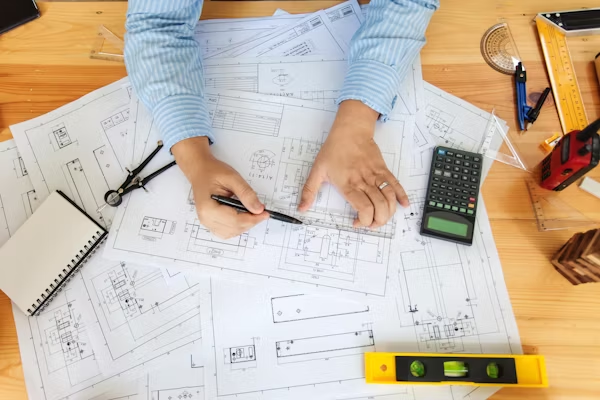
Modern construction doesn’t rely on difficult guesses scribbled on paper anymore. Today, the era plays a large role in making estimates precise and dependable. A Lumber Estimator can calculate the exact amount of timber required for framing, which reduces waste and stops expensive reorders. Likewise, a CAD Drafter facilitates turning raw ideas into digital drawings where cloth portions and dimensions may be measured with accuracy.
Construction Estimating Services frequently brings these gears together, blending human enjoyment with software precision. Instead of juggling spreadsheets or guesswork, experts can speedily become aware of how many nails, beams, or tiles will be needed.
The Human Element
Even with software, estimation is never as simple as clicking a button. Experience matters. A pro estimator knows that cloth fees range, delivery schedules slip, and weather can adjust a timeline. These insights allow for buffers and contingencies, ensuring the task isn’t derailed by means of the unexpected.
For instance, homes with identical rectangular footage can also nonetheless range in cost because one makes use of high-end finishes at the same time as the alternative opts for less complicated substances. Estimators ought to stabilize technical calculations with judgment calls, tailoring each estimate to the specific vision of the client.
Stages Where Estimation Shapes Outcomes
Cost estimation isn’t a one-time occasion. It publishes nearly every stage of a venture:
- Planning segment – Establishes whether or not the assignment is financially possible.
- Design development – Identifies how layout selections have an effect on charges, giving customers the chance to alter.
- Pre-construction – Refines the numbers as allowed; website conditions and final designs are shown.
- Construction – Acts as a benchmark for music to determine whether the assignment is staying on course.
At every degree, updates to the estimate assist in reducing uncertainty and sharpening the overall plan.
Common Pitfalls in Estimation
Even skilled professionals face demanding situations in forecasting fees. Some of the most common pitfalls include:
- Overlooking small, however repeated gadgets, like fasteners or fittings, that add up.
- Relying on old fabric costs.
- Failing to account for the exertion’s extra time or seasonal wage shifts.
- Ignoring site-unique challenges, together with bad soil conditions, or getting access to limitations.
Avoiding these mistakes requires diligence and a machine that double-tests each element.
Why Outsourcing Helps
Not each builder or property owner has the time or know-how to run designated value models. That’s where specialized Construction Estimating Services prove precious. By outsourcing this step, tasks benefit from dedicated professionals who work every day with converting marketplace records, constructing codes, and advanced estimating software. The result is fewer surprises and a smoother creation adventure.
Balancing Accuracy With Flexibility
One of the subtle arts of cost estimation is finding a balance between accuracy and adaptability. An estimate that’s too inflexible might not leave room for layout upgrades or unavoidable modifications. On the other hand, one that’s too free can endanger credibility. The excellent approach is to create a clear baseline, even while acknowledging that adjustments will show up as the mission unfolds.
The Ripple Effect of Good Estimation
Accurate fee forecasting does more than protect against financial headaches—it shapes the achievement of the entire project. When numbers are clean from the beginning:
- Teams speak extra effectively.
- Clients believe in the technique and sense greater cushy approving changes.
- Waste is minimized, both in materials and in time.
- Projects finish in the direction of their intended budget and schedule.
Final Thoughts
Construction isn’t pretty much concrete, metallic, or lumber—it’s approximately making plans, foresight, and precision. Cost estimation is the unsung hero that threads a lot of these pieces together. Whether supported with the aid of a Lumber Estimator, delicately dealt with with the aid of a CAD Drafter, or dealt with with the aid of expert Construction Estimating Services, the process guarantees that goals on paper can stand firmly inside the real world. In the end, the strength of any shape is built not only on its basis but also on the careful calculations that paved the way before the first shovel touched the ground.