We tend to treat “focus” as a purely mental discipline. We view it as a muscle we can flex, a state of mind we can summon with enough caffeine, willpower, and noise-canceling headphones.
- 1. The Biology of Stagnation: Why Sitting Kills Your “Flow”
- 2. The “Background Noise” of Discomfort
- 3. The Friction of Transition (Why Motor Mechanics Matter)
- 4. The Geometry of “The Shrug” (Height and Cognitive Load)
- 5. Visual Chaos and the “Cluttered Mind”
- The Ecosystem of Attention
- Frequently Asked Questions
When we lose focus—when our minds wander in the middle of a report, or when the afternoon brain fog rolls in like a tide—we blame our brains. We think we are tired. We think we are burned out. We think we need a new productivity app or a better to-do list.
But as industry curators who have spent years analyzing the intersection of design and human performance, we propose a different theory: You aren’t losing focus because you are undisciplined. You are losing focus because your body is distracted.
There is a concept in psychology known as “embodied cognition,” which suggests that our thoughts are deeply rooted in our physical sensations. If your body is uncomfortable, stagnant, or misaligned, your brain dedicates a significant portion of its processing power to managing that physical “noise.”
Your desk setup is not just a place where you put your laptop. It is the cockpit of your attention. If the cockpit is flawed, the pilot cannot fly.
Here is how the invisible mechanics of your workstation—the height of your surface, the angle of your hips, the flow of your blood—are dictating your cognitive performance, and how to fix them.
1. The Biology of Stagnation: Why Sitting Kills Your “Flow”
We often use the word “flow” to describe a state of deep, effortless concentration. But physiologically, flow requires… well, flow.
When you sit in a static position for hours, your metabolism enters a state of hibernation. Enzymes that break down fat drop by 90%. Your heart rate slows. Most critically, blood flow to the brain decreases.
A study published in the Journal of Applied Physiology found that prolonged sitting creates a “vascular stagnation.” Your brain literally receives less oxygen and glucose—the fuel it needs to process information. That 2 PM slump isn’t just about lunch; it’s about hypoxia.
The Fix: The “Active” Station This is the primary argument for the standing desk. It is not just about burning calories; it is about refueling the brain.
When you stand, you engage the large muscles in your calves and thighs. These muscles act as a pump, pushing fresh, oxygenated blood back up to the heart and brain. Users who switch to a standing desk often report a “lifting” of brain fog within minutes of rising. The simple act of standing up creates a physiological reset that reboots your attention span.
2. The “Background Noise” of Discomfort
Imagine trying to solve a complex math problem while someone is poking you in the shoulder with a sharp stick. You might be able to do it, but it will take twice as long and you will make more mistakes.
Physical discomfort is that stick.
Most people tolerate low-level pain—a tight neck, a numb glute, a slight ache in the wrist—thinking they can ignore it. But the brain does not ignore pain. It processes it as a threat. This creates a constant, low-level “background noise” that competes with your work for neural resources.
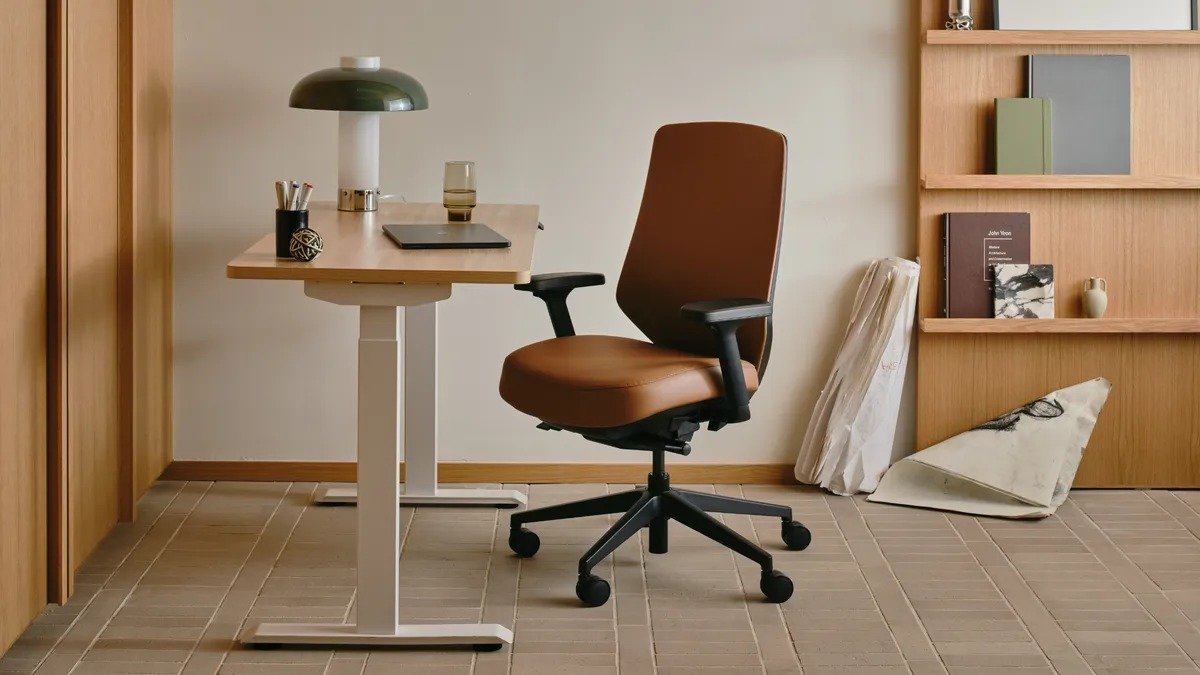
The Culprit: The “Almost Right” Chair Many people sit in a desk chair that is “fine.” It doesn’t hurt immediately, but it doesn’t support them either. Maybe the lumbar support is too low. Maybe the seat pan is too hard.
This forces your brain to constantly send micro-signals to your muscles: Tighten the core to hold us up. Shift the hip to relieve pressure. Arch the back. Your brain is multitasking between writing that email and keeping your body upright.
A truly ergonomic chair removes this cognitive load. By supporting your spine in neutral alignment, it tells your brain, “The body is safe. The body is supported. You can stop monitoring the body and focus entirely on the work.”
3. The Friction of Transition (Why Motor Mechanics Matter)
We know that we should move more. We know we should alternate between sitting and standing. So why don’t we?
Friction.
If changing your desk height involves hand-cranking a lever for 45 seconds, or clearing off your desk to lift a converter, you won’t do it. When you are in a deep mental state, your brain protects its focus by rejecting any task that requires high effort. The physical effort of moving the desk breaks the mental thread.
This is why the motor mechanics of your furniture matter more than you think. An electric desk removes the friction.
With a memory preset, the transition takes one button press and zero cognitive effort. You can stand up without stopping your typing. You can sit down without looking away from the screen. The movement becomes seamless, allowing your physical state to change while your mental state remains locked in.
4. The Geometry of “The Shrug” (Height and Cognitive Load)
Have you ever noticed that when you are stressed or trying to concentrate hard, your shoulders creep up toward your ears? This is a stress response.
But for many people, their desk forces them into this position.
Standard desks are 29 inches high. If you are 5’6″, that desk is likely 3 inches too high for your resting elbow height. To type, you must physically lift your shoulders. You are essentially holding a “stress pose” for 8 hours a day.
The Cognitive Cost: Holding your trapezius muscles in tension sends a feedback signal to your brain that says, “We are under stress.” This triggers a low-level “fight or flight” response (sympathetic nervous system activation), which creates anxiety and reduces your ability to think creatively or strategically.
The Fix: Precision. This is the hidden power of an adjustable desk. It allows you to lower the surface to your exact elbow height (often 25-27 inches). When your shoulders drop, your nervous system down-regulates. You physically relax, which clears the mental bandwidth for higher-level thinking.
5. Visual Chaos and the “Cluttered Mind”
Your peripheral vision is constantly scanning your environment. If your desk is cluttered with cables, papers, and coffee cups, your brain is subconsciously processing that visual data.
Princeton University researchers found that visual clutter competes for your attention, limiting your brain’s ability to process information. A messy desk literally exhausts your brain faster.
While this isn’t strictly about the furniture, the design of your furniture plays a huge role. A desk with built-in cable management, clean lines, and ample surface area allows you to create “negative space” around your work. This visual silence is the canvas upon which focus can be painted.
The Ecosystem of Attention
We need to stop viewing our office furniture as passive objects. They are active participants in our cognitive lives.
Your chair is either feeding you energy or draining it. Your desk is either aligning your body or distorting it.
Improving your focus isn’t just about downloading a meditation app. It’s about building an ecosystem that supports human physiology. It’s about the electric desk that encourages blood flow. It’s about the adjustable desk that drops your shoulders and lowers your stress. It’s about the standing desk that wakes you up at 3 PM, and the desk chair that makes your body invisible so your mind can fly.
If you want to think better, start by sitting (and standing) better.
Frequently Asked Questions
Q1: Does standing really help with focus, or is it just for back pain?
It helps with both. The “focus” benefit comes from increased blood circulation. Standing engages the “muscle pump” in your legs, which increases blood flow to the brain by up to 20% compared to sitting. This fresh oxygen helps clear “brain fog” and improves alertness.
Q2: Can an adjustable desk go low enough for me?
That depends on the desk. Many standard standing desks only go down to 28 or 29 inches. If you are under 5’10”, you should look for a “3-stage column” desk frame (like the Asteria) which typically descends to roughly 24 or 25 inches. This lower range is critical for seated ergonomic comfort.
Q3: How often should I switch between sitting and standing for maximum focus?
The ideal rhythm for cognitive performance seems to be frequent, short intervals. Rather than standing for 4 hours straight (which causes fatigue), try standing for 15-20 minutes every hour. This “pulse” of activity keeps your energy levels consistent without tiring you out.
Q4: Why do I feel more distracted when I first start using a standing desk?
This is normal. It’s a novelty distraction. Your body is getting used to the new sensation of balancing while working. It typically takes 3-5 days for the body to adapt. Once the standing posture becomes muscle memory, the distraction fades, and the focus benefits kick in.
Q5: Is a wobble stool better for focus than a regular chair?
For short bursts, yes. “Active sitting” stools keep your core engaged and can help fidgety thinkers stay alert. However, for deep, long-duration work, they lack the support needed for stability. A high-quality ergonomic desk chair is still the best foundation for sustained, deep focus sessions.